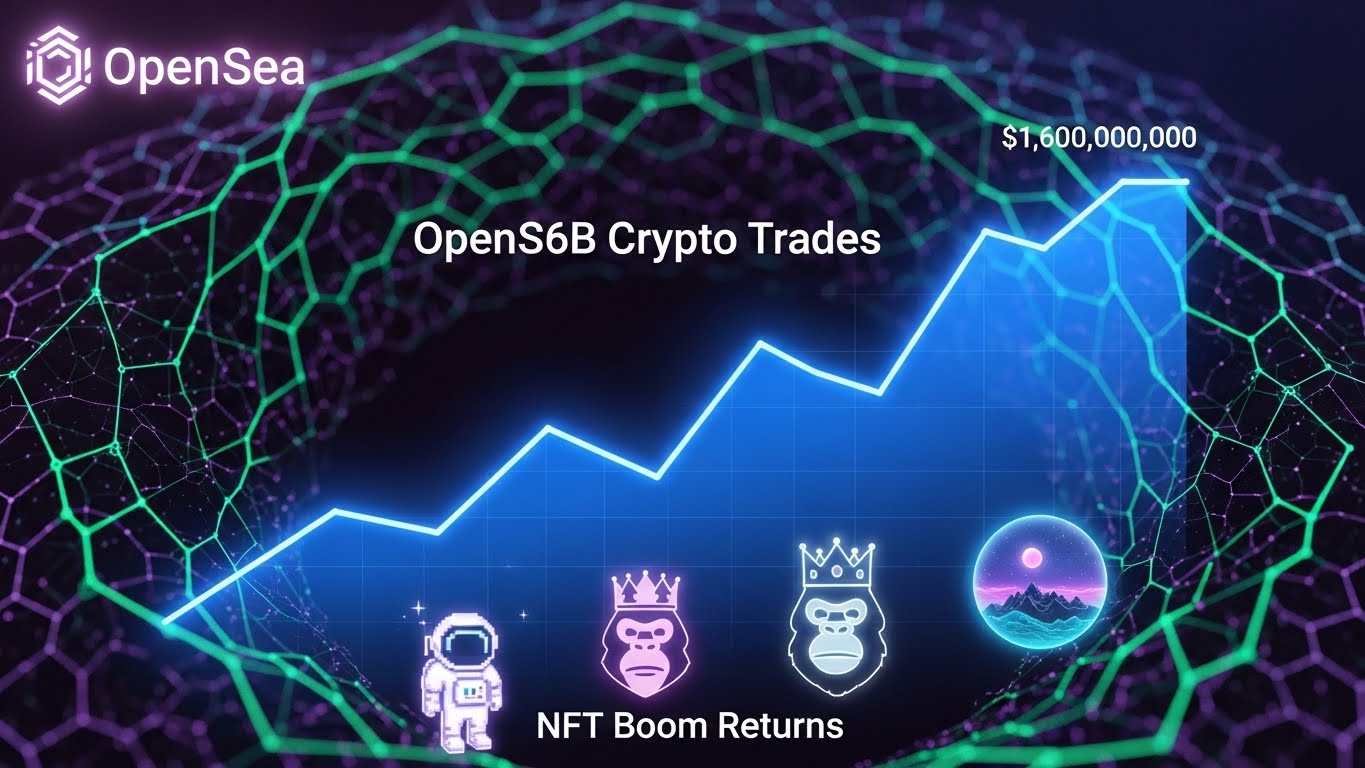

The digital collectibles landscape has witnessed a remarkable transformation as OpenSea crypto trades surged to an impressive $1.6 billion, signaling that the NFT boom returns with renewed vigor. This milestone represents more than just numbers on a blockchain—it marks a pivotal moment in the evolution of digital ownership and creative expression. After experiencing a challenging period throughout 2023 and early 2024, the world’s largest NFT marketplace has demonstrated that reports of the non-fungible token market’s demise were greatly exaggerated. The resurgence of OpenSea crypto trades reflects growing investor confidence, technological improvements, and a maturing ecosystem that has learned valuable lessons from previous market cycles.
The Remarkable Recovery of OpenSea’s Trading Volume
The journey back to $1.6 billion in crypto trades wasn’t instantaneous. OpenSea, which once dominated the NFT marketplace with over 90% market share, faced significant headwinds during the cryptocurrency winter of 2022 and 2023. Trading volumes plummeted as speculative fervor cooled and many questioned whether digital collectibles represented genuine value or merely a passing fad driven by hype and celebrity endorsements.
However, the recent surge in OpenSea crypto trades demonstrates a fundamental shift in how both creators and collectors approach the NFT space. Rather than focusing solely on quick profits and speculative flipping, the current wave of activity reflects a more sustainable approach centered on utility, community engagement, and authentic artistic expression. This maturation process has laid the groundwork for what many analysts now recognize as the second major wave of NFT adoption.
The $1.6 billion milestone encompasses transactions across multiple blockchain networks, including Ethereum, Polygon, Klaytn, and Solana. This multi-chain approach has significantly expanded OpenSea’s reach, allowing users to participate in the NFT market regardless of their preferred blockchain ecosystem or budget constraints related to transaction fees.
What’s Driving the NFT Boom Returns
Institutional Investment and Market Maturation
The current NFT boom returns with a distinctly different character than the speculative mania of 2021. Institutional investors, who once viewed digital collectibles with skepticism, have increasingly recognized NFTs as legitimate asset classes worthy of portfolio allocation. Major financial institutions, family offices, and venture capital firms have deployed significant capital into NFT infrastructure, marketplaces, and premium collections.
This institutional participation brings several advantages to the OpenSea crypto trades ecosystem. Professional investors conduct thorough due diligence, demand higher standards of transparency and security, and contribute to price discovery mechanisms that help establish more rational valuations. Their involvement also attracts regulatory clarity, which paradoxically strengthens the market by providing clear frameworks within which legitimate businesses can operate confidently.
Technological Improvements and User Experience
The technical infrastructure supporting OpenSea crypto trades has evolved dramatically since the platform’s early days. Gas fees on Ethereum, once a significant barrier to entry for casual users, have been substantially reduced through Layer 2 scaling solutions and the network’s transition to proof-of-stake consensus. These improvements make it economically viable to purchase, sell, and trade lower-priced NFTs without transaction costs exceeding the value of the assets themselves.
OpenSea has also invested heavily in user experience enhancements that make the platform more accessible to mainstream audiences. Simplified onboarding processes, improved search and discovery features, enhanced analytics tools, and better fraud prevention mechanisms have collectively reduced friction in the NFT market. These refinements demonstrate that the platform has listened to user feedback and prioritized practical improvements over flashy features.
Cultural Shift and Real-World Utility
Perhaps the most significant factor behind the NFT boom returns is the growing understanding of how digital ownership can create tangible value. Forward-thinking brands and creators have moved beyond simple profile picture collections to develop NFTs that unlock real-world experiences, exclusive content, membership benefits, and intellectual property rights.
Musicians are issuing NFTs that grant holders royalty shares in their songs. Fashion brands are creating digital wearables that exist both in virtual worlds and as redeemable physical items. Sports franchises are developing collectible moments that provide VIP access to games and meet-and-greet opportunities with athletes. This convergence of digital and physical value propositions has expanded the appeal of OpenSea crypto trades far beyond the cryptocurrency enthusiast community.
Breaking Down OpenSea’s $1.6B Trading Volume
Blue-Chip Collections Leading the Charge
A significant portion of the $1.6 billion in crypto trades comes from established, blue-chip NFT collections that have demonstrated staying power and cultural relevance. Collections like CryptoPunks, Bored Ape Yacht Club, Azuki, Doodles, and Art Blocks continue to command premium prices and generate substantial trading volume. These projects have built strong communities, delivered consistent value to holders, and established themselves as cultural touchstones within the digital art space.
The floor prices of these premium collections have stabilized and, in many cases, appreciated significantly from their bear market lows. This price recovery reflects renewed confidence among collectors who view these assets as long-term investments rather than speculative trading vehicles. The consistent trading activity in blue-chip collections provides liquidity and price discovery that benefits the entire NFT market.
Emerging Artists and New Collections
While established collections drive significant volume, the OpenSea crypto trades renaissance has also created opportunities for emerging artists and innovative new projects. The platform’s democratized approach allows creators worldwide to launch collections without gatekeepers or intermediaries, leading to an explosion of creative diversity.
Contemporary digital artists who previously struggled to monetize their work through traditional galleries and auction houses have found enthusiastic audiences on OpenSea. This direct connection between creators and collectors eliminates middlemen, allowing artists to retain larger portions of sale proceeds and build sustainable creative practices. The platform’s built-in royalty mechanisms ensure creators receive ongoing compensation when their works are resold on secondary markets.
Gaming and Metaverse Assets
Gaming NFTs and metaverse-related assets represent a rapidly growing category within OpenSea crypto trades. As virtual worlds become more sophisticated and interconnected, the demand for digital land parcels, in-game items, avatar accessories, and other virtual assets has accelerated. These items often have functional utility within their respective ecosystems, distinguishing them from purely collectible NFTs.
Play-to-earn gaming models, despite facing criticism and regulatory scrutiny in some jurisdictions, have demonstrated that blockchain-based ownership can create genuine economic opportunities for players. The ability to truly own in-game assets and transfer them across platforms or sell them on open markets like OpenSea fundamentally changes the relationship between game developers and players.
The Broader Implications for the Crypto Ecosystem
NFTs as a Gateway to Blockchain Adoption
The NFT boom returns serves a crucial function beyond generating trading volume on OpenSea. For millions of people, purchasing their first NFT represents their initial interaction with blockchain technology, cryptocurrency wallets, and decentralized applications. This onboarding process familiarizes users with concepts like private keys, gas fees, and transaction verification that apply across the entire crypto ecosystem.
Once users overcome the initial learning curve and establish comfort with these technologies through OpenSea crypto trades, they become more likely to explore other blockchain applications including decentralized finance protocols, governance systems, and blockchain-based social networks. NFTs thus function as an accessible entry point that drives broader adoption of Web3 technologies.
Economic Empowerment for Creators
The creator economy has been transformed by platforms that enable direct monetization, but NFTs and marketplaces like OpenSea take this empowerment to another level. The $1.6 billion in crypto trades represents not just collector enthusiasm but also substantial economic opportunities for creators who might otherwise struggle to earn fair compensation for their work.
Programmable royalties ensure artists receive ongoing revenue streams from secondary sales, addressing a long-standing problem in traditional art markets where creators typically only profit from initial sales. This mechanism aligns incentives between creators and collectors, as both parties benefit when artwork appreciates in value and changes hands. The transparency of blockchain records also helps combat art fraud and provenance issues that plague traditional markets.
Challenges and Criticisms Facing the NFT Market
Environmental Concerns and Sustainability
Despite the NFT boom returns, environmental criticisms continue to shadow the space. Early NFT minting and trading on proof-of-work Ethereum consumed substantial energy, contributing to carbon emissions. While Ethereum’s transition to proof-of-stake has reduced the network’s energy consumption by approximately 99.95%, concerns about the environmental impact of blockchain technology persist.
OpenSea and other responsible platforms have responded by supporting multiple blockchains with varying energy profiles, offering carbon offset options, and prioritizing environmentally friendly networks. The OpenSea crypto trades ecosystem increasingly recognizes that long-term sustainability requires addressing environmental concerns rather than dismissing them.
Speculation and Market Volatility
The dramatic price swings that characterize NFT market activity remain a double-edged sword. While volatility creates opportunities for traders to generate profits, it also introduces risks that can result in significant losses. The speculative nature of some NFT purchases means that buyers motivated primarily by potential financial returns may face disappointing outcomes.
Critics argue that excessive speculation distracts from the legitimate use cases and creative potential of NFTs, instead creating bubble-like conditions prone to dramatic corrections. The challenge for platforms like OpenSea involves fostering healthy market dynamics that balance collector enthusiasm with realistic value assessments and sustainable growth trajectories.
Fraud, Scams, and Intellectual Property Issues
The rapid growth of OpenSea crypto trades has unfortunately attracted bad actors seeking to exploit inexperienced users through various fraudulent schemes. Copycat collections that plagiarize existing artwork, phishing attacks targeting wallet credentials, wash trading to artificially inflate volume statistics, and rug pulls where project teams abandon developments after collecting funds all present ongoing challenges.
OpenSea has implemented various safeguards including verification badges for authentic collections, improved reporting mechanisms for suspected fraud, and educational resources to help users identify red flags. However, the decentralized nature of blockchain technology means that ultimate responsibility for security rests with individual users, requiring ongoing education and vigilance.
Future Outlook for OpenSea and the NFT Ecosystem
Integration with Traditional Industries
The next phase of the NFT boom returns will likely involve deeper integration with traditional industries including fashion, entertainment, real estate, and education. Major brands have already begun experimenting with NFT-based loyalty programs, limited edition digital collectibles tied to physical products, and tokenized memberships that unlock exclusive benefits.
As these experiments mature and demonstrate clear value propositions, OpenSea crypto trades should benefit from increasing mainstream adoption. The platform’s role as a trusted marketplace where both digital natives and traditional businesses can safely transact will become increasingly important as the NFT ecosystem expands beyond its cryptocurrency-focused origins.
Technological Evolution and Interoperability
Future growth in OpenSea crypto trades will depend partly on continued technological innovation. Cross-chain interoperability solutions that allow NFTs to move seamlessly between different blockchain networks will expand market liquidity and reduce fragmentation. Improved smart contract standards that enable more sophisticated functionality while maintaining security will unlock new use cases.
Virtual reality and augmented reality technologies will create immersive environments where NFTs can be displayed, experienced, and utilized in ways that transcend static images on screens. As these technologies converge, the line between digital and physical ownership will continue to blur, creating novel experiences that justify the valuations seen in NFT market activity.
Regulatory Clarity and Consumer Protection
The regulatory landscape surrounding NFTs remains somewhat uncertain, with different jurisdictions taking varying approaches to classification and oversight. Whether specific NFTs constitute securities, commodities, or entirely new asset categories has significant implications for how they can be marketed, traded, and taxed.
Greater regulatory clarity, while initially concerning to some decentralization advocates, will ultimately benefit the OpenSea crypto trades ecosystem by providing legal certainty that encourages institutional participation and protects consumers from fraud. Thoughtful regulation that preserves innovation while establishing basic consumer protections represents the optimal path forward.
Strategies for Participating in the NFT Market Revival
Research and Due Diligence
Anyone looking to participate in the NFT boom returns should approach the market with thorough research and realistic expectations. Understanding project fundamentals including team credentials, roadmap deliverables, community engagement, and utility propositions helps distinguish promising investments from purely speculative plays. Examining trading volume patterns, holder distribution, and price history on OpenSea provides valuable context for evaluating collections.
Diversification across multiple projects, artists, and use cases reduces concentration risk while allowing participation in various segments of the NFT market. Setting predetermined budgets and avoiding emotional decision-making driven by fear of missing out helps maintain discipline during periods of market excitement.
Building Knowledge and Community Connections
The most successful participants in OpenSea crypto trades typically invest time in education and community engagement before committing significant capital. Following respected analysts, joining Discord servers for interesting projects, attending virtual and physical NFT events, and experimenting with small purchases all contribute to developing informed perspectives.
Understanding the cultural context and community values surrounding different NFT projects provides insights that pure financial analysis might miss. Many of the most successful collections derive value from strong community bonds, shared identity, and collaborative experiences rather than solely from artistic merit or scarcity.
Long-Term Perspective and Patience
While the headline $1.6 billion in crypto trades might suggest easy profits, sustainable success in the NFT market typically requires patience and long-term thinking. The most substantial returns often accrue to early supporters who believed in projects before mainstream recognition arrived, enduring periods of doubt and price volatility.
Treating NFT purchases as long-term investments or genuine collectibles rather than short-term trading vehicles aligns expectations with the reality that most projects require time to develop utility, build communities, and achieve their full potential. This approach reduces the psychological pressure of constant price monitoring and allows collectors to enjoy the actual ownership experience.
Conclusion: Embracing the NFT Renaissance
The impressive milestone of OpenSea crypto trades reaching $1.6 billion confirms what many observers suspected—the NFT boom returns not as a fleeting trend but as an enduring component of the digital economy. This resurgence reflects maturation, learning from past mistakes, and a growing understanding of how blockchain-based ownership can create genuine value across countless applications.
Whether you’re an artist seeking new monetization channels, a collector passionate about digital culture, an investor looking for alternative assets, or simply someone curious about emerging technologies, the current NFT market environment offers opportunities worth exploring. The key lies in approaching this space with informed optimism, recognizing both its transformative potential and its remaining challenges.
As OpenSea crypto trades continue expanding and the platform evolves to meet user needs, the foundation is being laid for a future where digital ownership is as natural and ubiquitous as physical possession. The $1.6 billion trading volume represents not an endpoint but a milestone on a much longer journey toward mainstream blockchain adoption. Now is the time to educate yourself, engage with communities, and consider how the NFT boom returns might impact your creative or investment pursuits. Explore OpenSea today and discover the vibrant ecosystem of digital collectibles reshaping our understanding of art, ownership, and value in the digital age.
See more: My Decade Journey from Bitcoin Beginner to Strategic Crypto