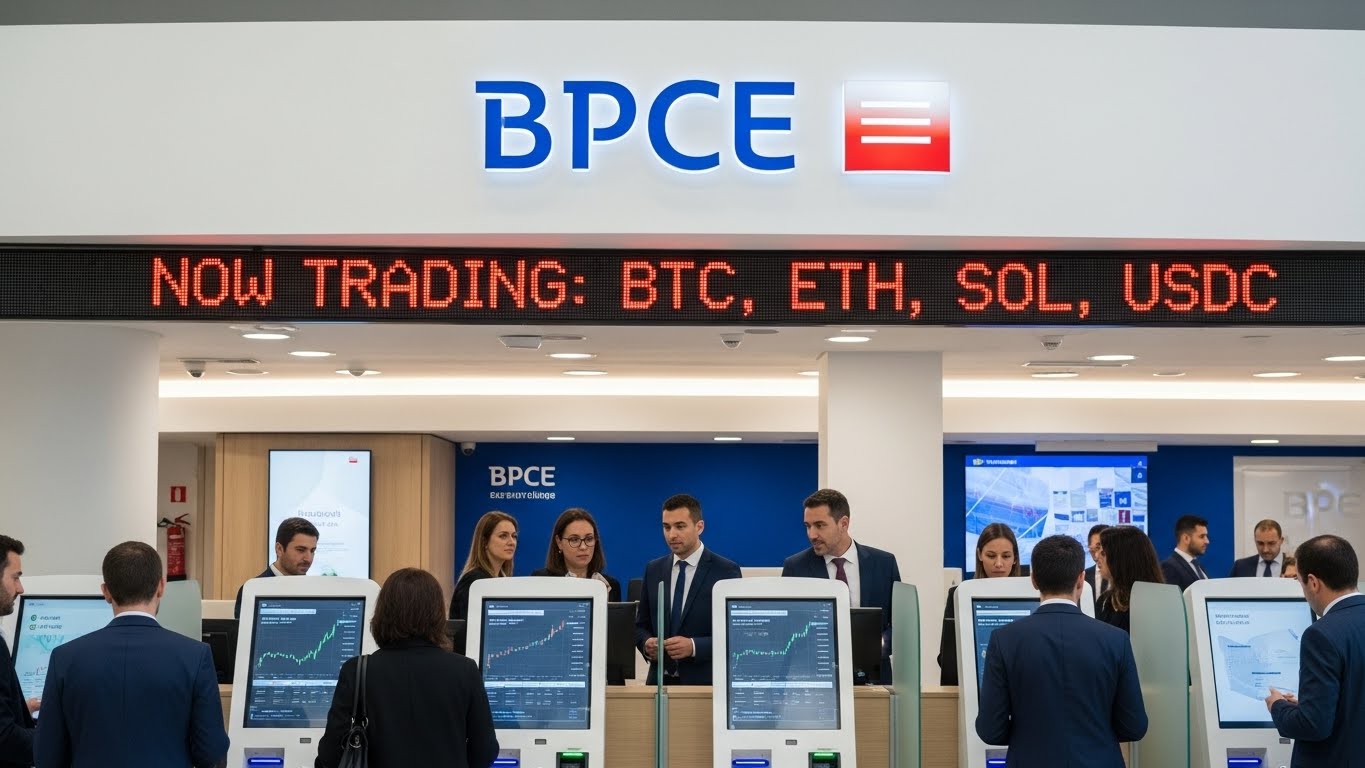

French Bank BPCE has just taken a decisive step into regulated crypto trading, allowing customers to buy and sell Bitcoin (BTC), Ethereum (ETH), Solana (SOL) and the stablecoin USDC directly inside its mainstream banking apps. Instead of sending users to separate exchanges or risky platforms, BPCE has embedded digital asset trading within the familiar interfaces of its Banque Populaire and Caisse d’Épargne mobile applications.
This move is not a small experiment. BPCE is France’s second-largest banking group, with tens of millions of clients across the country. The rollout begins with around two million customers at a handful of regional banks and is set to expand gradually across the group through 2026, ultimately covering BPCE’s entire 12-million retail base and potentially reaching up to 35 million customers via its wider networks.
Behind the scenes, the service relies on Hexarq, BPCE’s dedicated digital asset subsidiary, which recently secured full authorization from France’s financial markets regulator, the Autorité des Marchés Financiers (AMF), as a crypto asset service provider. This allows BPCE to offer custody, buying, selling and euro-crypto trading within a tightly regulated framework that aligns with the European Union’s MiCA rules.
For French retail customers, that means something simple but powerful: the ability to gain crypto exposure through a traditional bank they already trust, without having to learn a new platform or worry about shady offshore exchanges. For the broader market, BPCE’s launch is a clear sign that crypto adoption in Europe’s banking sector is entering a more mature, regulated phase.
Who Is BPCE and Why This Move Matters
BPCE is one of Europe’s top ten banking groups and a central pillar of the French financial system. It was formed from the merger of the cooperative networks Banque Populaire and Caisse d’Épargne, which together dominate retail banking in many regions across France. These networks serve millions of households, small businesses and local institutions, managing well over a trillion euros in assets.
Until recently, BPCE had taken a conservative stance toward digital assets. While some neobanks and fintechs embraced crypto trading early, BPCE focused on traditional savings and investment products and kept digital assets at arm’s length. That changed when the bank created Hexarq in 2021, a specialized unit focused on cryptocurrencies and tokenized real-world assets (RWAs). Hexarq quietly developed infrastructure, risk controls and compliance systems tailored to digital assets, preparing BPCE for a future where crypto would be part of mainstream finance.
The turning point came when Hexarq obtained PSAN / CASP authorization from the AMF. This status places Hexarq among a very small group of entities in France legally permitted to offer a full suite of crypto services, and it makes BPCE only the second major bank in the country, after Société Générale’s SG Forge, to operate a regulated crypto platform.
Because of its scale and cooperative structure, when French Bank BPCE moves, the market pays attention. By moving from cautious observation to live in-app trading of BTC, ETH, SOL and USDC, the bank is signaling that crypto is no longer a marginal experiment, but a strategic pillar for customer engagement and long-term competitiveness.
How BPCE’s New Crypto Trading Service Works
In-App Trading Through Familiar Banking Apps
The core of the offer is in-app crypto trading embedded directly into BPCE’s existing mobile banking interfaces. Customers of selected Banque Populaire and Caisse d’Épargne regional banks can log into the same app they already use to check balances or pay bills and find a new section dedicated to digital assets.
All of this takes place inside a regulated banking environment, without redirecting users to external exchanges or third-party wallets. That is a huge usability upgrade for everyday customers who want crypto exposure but feel uneasy about sending funds to unfamiliar global platforms.
Dedicated Digital Asset Accounts and Fees
Instead of mixing crypto balances with traditional bank accounts, BPCE has opted for a separate digital asset account managed by Hexarq. According to reports, this account comes with a fixed monthly fee of €2.99 and a 1.5% commission per trade, subject to a low minimum.
Structuring the product this way serves several purposes. It clearly distinguishes regulated crypto services from traditional banking products, simplifies compliance, and creates a transparent revenue model. Customers know exactly what they pay for access to secure, bank-integrated crypto custody and trading.
Phased Rollout to Millions of Customers
BPCE is not switching on crypto trading for everyone at once. The group is following a phased rollout strategy, starting with around two million clients across four regional entities, including Banque Populaire Île-de-France and Caisse d’Épargne Provence-Alpes-Côte d’Azur.
A controlled launch allows BPCE and Hexarq to:
Monitor customer demand and trading behavior
Stress-test infrastructure and risk controls
Collect feedback on user experience and education
Refine communications about volatility and risk
If performance, risk and customer feedback align with expectations, BPCE plans to extend the service across its remaining regional banks through 2026, ultimately integrating crypto trading for the entire retail customer base.
Hexarq: The Engine Behind BPCE’s Crypto Expansion
At the heart of this initiative is Hexarq, the digital asset platform that powers BPCE’s offer. Hexarq was launched in 2021 with a specific mission: to create a regulated ecosystem of crypto services for both retail and high-net-worth clients, as well as to explore tokenized assets and blockchain-based financial instruments.
With its PSAN / CASP authorization from the AMF, Hexarq is allowed to provide:
Secure custody of digital assets
Buying and selling of cryptocurrencies for euros
Trading infrastructure that connects bank accounts and crypto wallets
This regulatory greenlight is not just a box-ticking exercise. France has adopted some of the strictest and most forward-looking crypto regulations in Europe, especially in preparation for MiCA, the EU-wide framework for digital assets. By complying with these requirements, Hexarq can offer regulated crypto trading that meets the standards of mainstream banking supervision.
In other words, Hexarq is designed to deliver the convenience of modern crypto platforms but with the reliability and accountability of a traditional French bank.
Why BTC, ETH, SOL and USDC Were Chosen
This set reflects a strategic balance between blue-chip cryptocurrencies and a major regulated stablecoin. BTC is the flagship store of value in the crypto market, widely seen as digital gold. ETH powers the Ethereum ecosystem, which underpins much of decentralized finance and tokenization. SOL represents exposure to a fast-growing high-performance blockchain used for payments, DeFi and consumer apps. USDC provides a dollar-pegged stablecoin option that can act as a stepping stone between traditional currencies and crypto volatility.
By limiting the initial selection to these four, BPCE is prioritizing:
The bank can always expand the list later, but starting with a focused range makes it easier to explain the basics of crypto investing to a mass-market audience and to maintain strong risk controls.
Impact on the French and European Crypto Landscape
A New Phase of Bank-Led Crypto Adoption
For years, crypto adoption in Europe was driven mainly by exchanges, brokers and neobanks, while large traditional institutions mostly stood on the sidelines. With French Bank BPCE bringing in-app crypto trading to millions of everyday customers, that balance is shifting.
BPCE is not alone. Banks such as BBVA in Spain, Santander’s Openbank and Raiffeisen Bank’s Austrian unit have already introduced similar services, allowing customers to buy and hold digital assets through their banking apps. But BPCE’s size and cooperative network give this move special weight within the eurozone.
A major, systemically important bank offering BTC, ETH, SOL and USDC trading sends a strong signal that crypto is no longer a peripheral, speculative corner of finance. Instead, it is becoming an integrated product category, similar to mutual funds or foreign currencies, offered under strict regulation and backed by familiar brands.
Alignment with MiCA and French Regulatory Strategy
France has positioned itself as one of Europe’s leaders in crypto regulation, with frameworks such as the PSAN regime and early adoption of the MiCA rules. The AMF’s authorization of Hexarq as a crypto asset service provider fits this strategy: encourage innovation but demand high standards of compliance, transparency and consumer protection.
By working within this framework, BPCE benefits from:
Clear standards for customer onboarding and risk disclosures
Defined responsibilities for custody and asset segregation
Supervision that helps build trust among regulators and the public
At the same time, France’s evolving tax rules, including proposals to treat certain digital assets as “unproductive wealth” subject to specific wealth taxes, underline that crypto is being integrated into the mainstream fiscal system as well.
What It Means for Everyday French Customers
Easier Access and Lower Friction
For the average French saver, the new BPCE service removes several barriers that previously made crypto feel intimidating. There is no need to:
Instead, customers can use the same app, same login and same bank relationship they already trust. That makes it far easier to experiment with small allocations to Bitcoin, Ethereum, Solana or USDC, or to keep a portion of savings in digital assets without stepping too far outside their comfort zone.
A More Secure Alternative to Unregulated Platforms
One of crypto’s biggest problems has been counterparty risk: platforms collapsing, funds being frozen or stolen, or regulatory crackdowns catching users off guard. By integrating crypto services into a fully regulated French bank, BPCE offers an alternative that may feel safer for many households.
Of course, market risk does not disappear. Prices of BTC, ETH and SOL can still be highly volatile, and customers can lose money if markets move against them. But the operational and legal risk of dealing with unknown offshore entities is significantly reduced when everything happens under the umbrella of a well-capitalized French institution supervised by the AMF and the European Central Bank.
Opportunities and Risks for BPCE
Strengthening Customer Loyalty and Attraction
From BPCE’s perspective, crypto trading is both a retention and acquisition tool. As more French citizens explore digital assets, banks that ignore this demand risk watching customers move balances to fintechs and exchanges. By offering a secure, compliant crypto service, BPCE can:
Regulated crypto investing becomes another way to stay relevant for younger generations who expect their bank to support both traditional and digital finance.
Managing Volatility, Education and Reputational Risk
At the same time, BPCE must navigate several challenges. Crypto markets are famous for sharp price swings, and customers who buy at peaks may suffer painful losses. That risk can quickly become a reputational issue if users blame the bank for encouraging them into an asset they did not fully understand.
If done well, French Bank BPCE’s crypto rollout could become a model of how traditional banks offer digital assets responsibly. If mishandled, it could revitalize old narratives about crypto being too risky for everyday investors.
The Bigger Picture: Traditional Finance and Crypto Converge
BPCE’s launch of BTC, ETH, SOL and USDC trading inside mainstream banking apps is more than just a product update. It is a snapshot of a deeper trend: the convergence of traditional finance (TradFi) and digital assets.
On one side, you have a cooperative banking giant with more than a century of history, deeply embedded in France’s economic fabric. On the other, a set of decentralized networks and digital tokens that emerged less than two decades ago. For years, these worlds developed in parallel, often suspicious of one another.
Now, through initiatives like Hexarq and in-app crypto accounts, the two are being woven together. Traditional banks bring regulation, capital, risk management and customer trust. Crypto brings programmability, global liquidity, twenty-four-hour markets and new forms of digital value.
The result, if successful, is a new type of financial ecosystem where Bitcoin and stablecoins sit alongside savings accounts and mortgages, not as exotic alternatives but as integrated options. BPCE’s move is an important step toward that future for millions of people in France.
Conclusion
French Bank BPCE’s decision to roll out BTC, ETH, SOL and USDC trading directly inside its Banque Populaire and Caisse d’Épargne apps is a watershed moment for regulated crypto adoption in France. Backed by Hexarq’s AMF authorization and framed by Europe’s emerging MiCA rules, the service combines the convenience of modern digital asset platforms with the familiarity and security of a major French bank.
The coming years will show how quickly customers adopt these tools, how responsibly they are used, and how far BPCE will go in expanding its crypto offering. But one thing is already clear: the line between your bank account and your digital asset portfolio is getting thinner, and BPCE is helping to redraw it.
FAQs
Which cryptocurrencies can I trade through French Bank BPCE?
Through BPCE’s new in-app crypto service, eligible customers can currently trade Bitcoin (BTC), Ethereum (ETH), Solana (SOL) and the stablecoin USDC. These assets were chosen because they combine strong liquidity, established market positions and relatively clearer regulatory treatment, especially in the cases of BTC and ETH. The selection focuses on major digital assets rather than speculative tokens, which makes it easier for new investors to understand what they are buying and to manage risk more sensibly. In the future, BPCE and Hexarq may expand this list, but any additions are likely to go through the same rigorous risk and compliance filters.
How do BPCE’s crypto accounts differ from normal bank accounts?
You move funds from your euro account into the crypto account when you want to invest, and move them back when you sell. This separation simplifies accounting, risk control and regulatory reporting, and it also gives customers a clear mental distinction between traditional savings and higher-risk digital asset exposure.
Is trading crypto with BPCE safer than using a regular exchange?
From an operational and regulatory standpoint, trading with BPCE offers clear advantages over many unregulated or lightly supervised platforms. Hexarq operates under AMF authorization as a crypto asset service provider and must follow strict rules on custody, client asset segregation, reporting and anti-money-laundering procedures. Your relationship is with a major French bank that is already familiar and subject to extensive oversight. However, this does not eliminate market risk. The prices of BTC, ETH and SOL can still fluctuate sharply, and losses are possible. What BPCE really provides is a more secure and accountable environment in which to access those markets, not a guarantee of positive returns.
What fees apply when I trade BTC, ETH, SOL or USDC with BPCE?
According to reports, the digital asset account provided through Hexarq charges a fixed monthly fee, currently around €2.99, plus a 1.5% commission on each trade, subject to a modest minimum amount. These fees cover the cost of custody, trading infrastructure, security and ongoing regulatory compliance. While that may be higher than some low-cost offshore exchanges, many customers will see value in paying for a regulated, bank-integrated service that they can access through the same app they already use for everyday banking. As always, it is important to check the latest pricing in your own BPCE app, since fees can evolve over time.
What does BPCE’s crypto launch mean for the future of banking in France?
BPCE’s in-app crypto trading is a strong signal that digital assets are becoming part of mainstream banking, rather than existing at the fringes through independent platforms. As one of France’s biggest groups, BPCE is effectively normalizing the idea that customers should be able to hold Bitcoin, Ethereum, Solana and stablecoins alongside traditional products, within a regulated and supervised framework. This is likely to push other banks to accelerate their own digital asset strategies, deepen cooperation with regulators and invest more in education and risk management tools. Over time, French customers can expect an increasingly rich menu of tokenized assets, crypto-related savings products and blockchain-enabled services, all offered through the same trusted institutions that already manage their everyday finances.
See more;Crypto Entrepreneur’s Father Kidnapped for Bitcoin in France