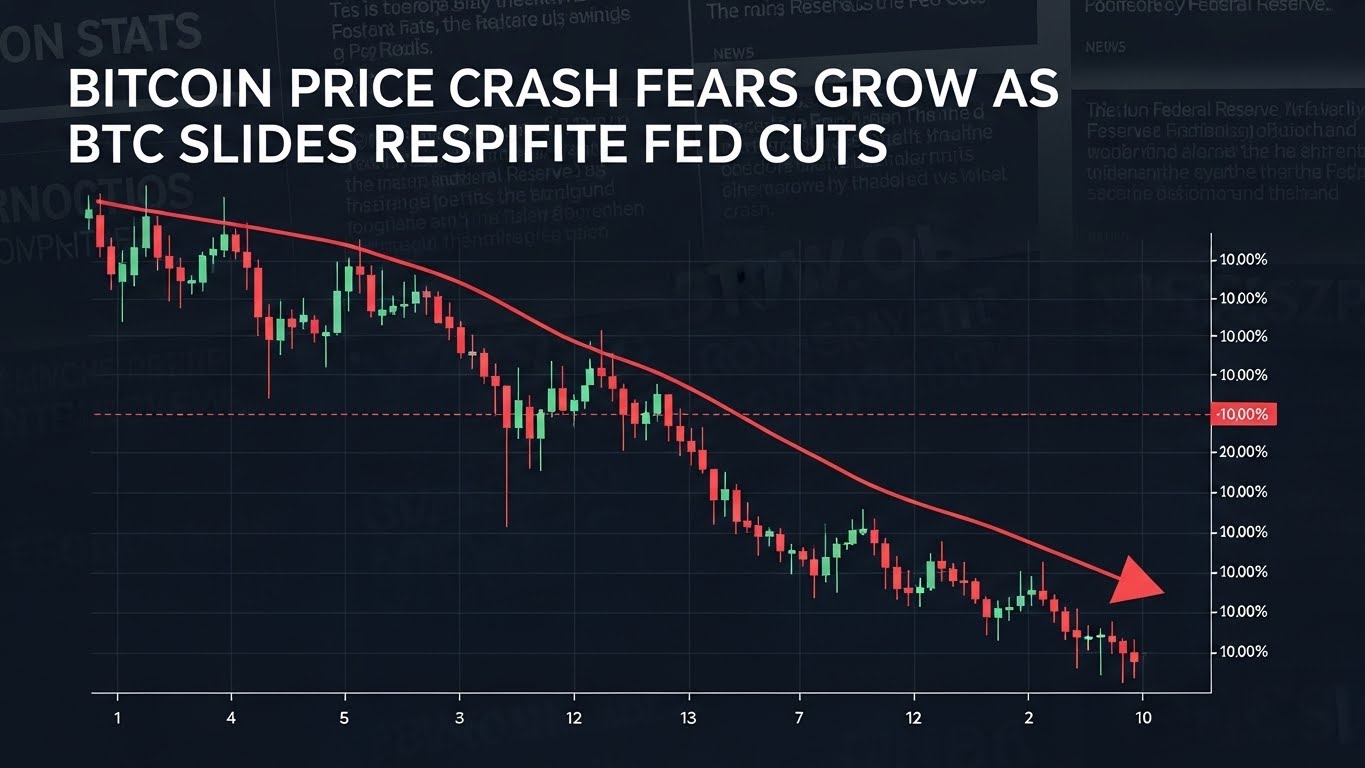

Bitcoin price crash fears continue to escalate despite the Federal Reserve’s recent decision to cut interest rates. Investors worldwide are watching anxiously as Bitcoin (BTC) slides below critical support levels, raising questions about the sustainability of the digital asset’s long-term value proposition. The paradoxical situation where Bitcoin price crash fears intensify even amid traditionally bullish monetary policy has left many market participants puzzled and concerned about the future trajectory of the world’s largest cryptocurrency.
This unexpected downturn comes at a time when conventional wisdom suggested that lower interest rates would propel Bitcoin higher, making the current price action particularly alarming for both institutional and retail investors who positioned themselves for a rally.
Current Bitcoin Market Situation
The Disconnect Between Fed Policy and Bitcoin Performance
The Bitcoin price crash fears gripping the market stem from a fundamental disconnect between traditional financial theory and cryptocurrency market behavior. Historically, when the Federal Reserve reduces interest rates, risk assets like Bitcoin tend to appreciate as investors seek higher returns outside of traditional fixed-income securities. However, the current market dynamics tell a different story.
Bitcoin has declined approximately 8-12% in recent weeks, with prices hovering around critical psychological support levels. This downward pressure persists despite the Fed’s accommodative monetary stance, which typically injects liquidity into financial markets and encourages speculative investment in alternative assets like cryptocurrencies.
Why Traditional Safe-Haven Narratives Are Failing
Many cryptocurrency advocates have long promoted Bitcoin as “digital gold” – a hedge against inflation and monetary debasement. Yet as Bitcoin price crash fears mount, this narrative is being tested. The cryptocurrency market crash concerns are amplified by several converging factors that challenge Bitcoin’s safe-haven status.
Institutional investors who entered the space expecting Bitcoin to behave as an inflation hedge are now questioning their assumptions. The correlation between Bitcoin and traditional risk assets has increased significantly, suggesting that BTC is trading more like a tech stock than a store of value during periods of market stress.
Key Factors Driving Bitcoin Price Crash Fears
Global Economic Uncertainty and Recession Concerns
The Bitcoin price crash fears are not occurring in a vacuum. Global economic uncertainty plays a crucial role in the current crypto market downturn. Despite rate cuts, recession fears loom large across major economies, prompting investors to flee to traditional safe havens like U.S. Treasury bonds and the dollar rather than cryptocurrencies.
Economic indicators including inverted yield curves, declining manufacturing output, and weakening consumer confidence are painting a sobering picture. In this environment, Bitcoin’s volatility becomes a liability rather than an opportunity, as investors prioritize capital preservation over speculative gains.
Regulatory Pressures Intensifying Worldwide
Regulatory scrutiny represents another significant factor amplifying Bitcoin price crash fears. Governments worldwide are implementing stricter cryptocurrency regulations, creating uncertainty about the long-term viability of digital asset markets. Recent enforcement actions by the Securities and Exchange Commission (SEC) and similar bodies in Europe and Asia have created a chilling effect on Bitcoin market volatility.
The regulatory landscape continues to evolve rapidly, with proposed legislation targeting everything from cryptocurrency exchanges to decentralized finance (DeFi) protocols. This regulatory uncertainty contributes to risk aversion among institutional investors who require clear legal frameworks before committing significant capital.
Technical Analysis Reveals Bearish Signals
From a technical perspective, the BTC price analysis presents concerning signals that validate growing Bitcoin price crash fears. Key technical indicators are flashing red across multiple timeframes, suggesting that further downside may be imminent.
Bitcoin has broken below several important moving averages, including the 200-day moving average that many traders consider the dividing line between bull and bear markets. The Relative Strength Index (RSI) shows continued weakness, while trading volumes have declined significantly, indicating a lack of buying conviction even at current reduced prices.
Support levels that previously held firm during minor corrections are now being tested repeatedly, raising concerns that a capitulation event could trigger a cascade of selling pressure as stop-losses are triggered and leveraged positions are liquidated.
The Federal Reserve Rate Cut Paradox
Why Lower Rates Aren’t Helping Bitcoin
The central paradox fueling Bitcoin price crash fears is the cryptocurrency’s failure to rally despite traditionally bullish Federal Reserve interest rates policy. Understanding this disconnect requires examining the broader context of why the Fed is cutting rates in the first place.
Rate cuts in response to economic weakness signal different market conditions than rate cuts aimed at stimulating growth during stable times. Current reductions appear more defensive, aimed at preventing economic deterioration rather than encouraging risk-taking. In this context, investors interpret rate cuts as confirmation of economic problems rather than as an all-clear signal to buy risk assets.
Liquidity Concerns Despite Monetary Easing
While the Fed has reduced rates, actual liquidity conditions in financial markets remain tight. The cryptocurrency recession fears are compounded by the fact that lower nominal rates haven’t translated into easier credit conditions or increased risk appetite. Banks remain cautious about lending, and quantitative tightening continues to drain liquidity from the system.
For Bitcoin, which thrived during the unprecedented liquidity injections of 2020-2021, the current environment represents a stark contrast. Without abundant liquidity flowing into speculative assets, Bitcoin investment risks become more apparent, and the asset struggles to maintain its valuation.
Investor Sentiment and Market Psychology
Fear and Greed Index Signals Extreme Fear
The Bitcoin price crash fears are reflected prominently in sentiment indicators. The Crypto Fear and Greed Index has plunged into extreme fear territory, suggesting that panic selling may be driving prices lower rather than rational valuation assessments. This psychological capitulation often precedes further declines as fearful investors rush to exit positions.
Social media sentiment analysis reveals increasingly bearish discussions across cryptocurrency communities. The shift from euphoria to pessimism happened remarkably quickly, demonstrating the fragility of market confidence in the digital currency decline.
Institutional Investors Reducing Exposure
Perhaps most concerning for long-term Bitcoin price prediction models, institutional investors are actively reducing their cryptocurrency exposure. Hedge funds, family offices, and even some publicly traded companies that embraced Bitcoin during the bull market are now selling positions or hedging their exposure.
This institutional retreat amplifies Bitcoin price crash fears because these sophisticated investors typically have longer time horizons and stronger conviction than retail traders. Their decision to reduce exposure suggests fundamental concerns about Bitcoin’s near-term prospects rather than temporary profit-taking.
Comparing Current Conditions to Previous Crashes
Lessons from the 2018 Bear Market
The current cryptocurrency market crash concerns echo the devastating 2018 bear market when Bitcoin lost over 80% of its value from peak to trough. However, there are both similarities and differences worth noting. Like 2018, the current decline follows a period of exuberant speculation and mainstream adoption hype.
The key difference lies in the maturity of the market. In 2018, cryptocurrency infrastructure was less developed, institutional participation was minimal, and regulatory frameworks were virtually non-existent. Today’s market features more sophisticated infrastructure, greater institutional involvement, and clearer (though still evolving) regulations.
The 2020 COVID Crash and Rapid Recovery
The March 2020 crash offers another instructive comparison for current Bitcoin price crash fears. Bitcoin plummeted over 50% in a matter of days as global panic over the pandemic triggered indiscriminate selling across all asset classes. However, Bitcoin recovered rapidly as unprecedented fiscal and monetary stimulus flooded into markets.
The crucial question is whether current conditions resemble 2020’s temporary liquidity crisis or 2018’s prolonged bear market. The answer will largely determine whether Bitcoin market volatility represents a buying opportunity or the beginning of a extended downturn.
What’s Next for Bitcoin: Expert Predictions and Scenarios
Bullish Case: Accumulation Before the Next Rally
Despite Bitcoin price crash fears, some analysts maintain optimistic outlooks. The bullish case argues that current weakness represents healthy consolidation after rapid gains, providing opportunities for long-term investors to accumulate at attractive prices. Proponents point to Bitcoin’s halving cycle and historical tendency to recover from major drawdowns.
Bulls argue that macroeconomic conditions will eventually improve, regulatory clarity will emerge, and Bitcoin’s fundamental value proposition as a decentralized, scarce digital asset remains intact. They view the crypto market downturn as temporary noise in a longer-term uptrend.
Bearish Case: Further Downside Ahead
The bearish perspective suggests that Bitcoin price crash fears are justified and that significantly lower prices lie ahead. Bears point to deteriorating macroeconomic conditions, tightening financial conditions despite rate cuts, regulatory crackdowns, and Bitcoin’s failure to act as an inflation hedge as evidence that the cryptocurrency’s bull thesis has broken down.
Technical analysis from bearish analysts identifies potential downside targets that would represent 40-60% declines from current levels, putting Bitcoin back to prices last seen in early 2023 or even late 2022. Such a scenario would constitute a full-blown Bitcoin bear market requiring years of recovery.
Most Likely Scenario: Extended Consolidation
A middle-ground perspective suggests that Bitcoin may enter an extended period of consolidation, trading within a broad range as the market digests previous gains and awaits catalysts for the next directional move. This scenario acknowledges Bitcoin investment risks while recognizing the asset’s resilience and potential for eventual recovery.
In this view, the BTC price analysis suggests that Bitcoin needs time to establish a stable base before attempting another sustained rally. The consolidation period could last months or even quarters, testing investor patience but ultimately setting the stage for future growth once conditions improve.
Strategies for Navigating Bitcoin Price Crash Fears
Risk Management in Volatile Markets
Addressing Bitcoin price crash fears requires disciplined risk management. Investors should never allocate more capital to cryptocurrency than they can afford to lose completely. Position sizing becomes critical during periods of heightened Bitcoin market volatility, as overleveraged positions can be wiped out by sharp price swings.
Dollar-cost averaging (DCA) offers one approach to navigating uncertainty, allowing investors to build positions gradually rather than attempting to time market bottoms. Setting clear stop-loss levels and taking partial profits during rallies helps protect capital while maintaining exposure to potential upside.
Diversification Beyond Bitcoin
While Bitcoin dominates cryptocurrency market capitalization, the cryptocurrency market crash concerns highlight the importance of diversification. Investors might consider exposure to alternative cryptocurrencies with different use cases, though this introduces additional complexity and risk.
Beyond crypto, maintaining balanced portfolios that include traditional assets provides crucial stability during digital currency decline periods. Stocks, bonds, real estate, and commodities each offer different risk-return profiles that can offset cryptocurrency volatility.
Long-Term Perspective and Fundamental Analysis
Surviving Bitcoin price crash fears often requires maintaining a long-term perspective focused on fundamentals rather than short-term price action. Evaluating Bitcoin’s adoption metrics, network security, technological development, and utility provides context beyond market sentiment.
Investors who believe in Bitcoin’s long-term value proposition may view current weakness as opportunity rather than catastrophe. However, this approach requires genuine conviction and the financial capacity to withstand extended drawdowns without forced selling.
Impact on the Broader Cryptocurrency Ecosystem
Altcoin Markets Suffering Even More
The Bitcoin price crash fears have devastating implications for alternative cryptocurrencies, which typically experience amplified volatility compared to Bitcoin. Many altcoins have declined 20-40% or more as Bitcoin weakens, with smaller-cap projects facing existential threats.
The correlation between Bitcoin and altcoin prices remains strong, meaning that Bitcoin’s struggles create headwinds for the entire cryptocurrency market crash scenario. Projects with weak fundamentals or insufficient treasury reserves may not survive an extended bear market, leading to further consolidation in the space.
Mining Industry Under Pressure
Bitcoin miners face mounting pressure as the crypto market downturn squeezes profitability. Lower Bitcoin prices combined with relatively stable (or rising) energy costs compress margins, forcing less efficient operations offline. Hash rate declines could follow if conditions persist, though Bitcoin’s difficulty adjustment mechanism provides some stability.
The mining industry’s struggles add another dimension to Bitcoin price crash fears, as miner capitulation events historically coincide with local price bottoms. Monitoring miner behavior provides valuable insights into market conditions and potential turning points.
DeFi and NFT Sectors Facing Challenges
The broader cryptocurrency ecosystem extends beyond simple price speculation, encompassing decentralized finance (DeFi) protocols and non-fungible token (NFT) markets. Both sectors are experiencing significant challenges amid Bitcoin investment risks and declining market confidence.
DeFi total value locked (TVL) has declined substantially, while NFT trading volumes have collapsed from 2021-2022 peaks. These developments suggest that the current downturn represents more than just Bitcoin price weakness—it reflects broader skepticism about cryptocurrency utility and sustainability.
Conclusion
The intensifying Bitcoin price crash fears despite Federal Reserve interest rate cuts represent a critical inflection point for the cryptocurrency market. The paradoxical situation where traditionally bullish monetary policy fails to support Bitcoin prices highlights the complex dynamics at play in today’s financial environment.
While Bitcoin market volatility creates genuine risks for investors, it also generates opportunities for those with appropriate risk tolerance and long-term perspectives. The key to navigating this turbulent period lies in maintaining disciplined risk management, avoiding emotional decision-making, and focusing on fundamental rather than speculative value.
Whether current conditions represent a temporary setback or the beginning of a prolonged Bitcoin bear market remains uncertain. What’s clear is that the cryptocurrency landscape continues to evolve, and investors must adapt their strategies accordingly.
See more;MSTR’s $1.44B Shield Against the Bitcoin Sell-Off