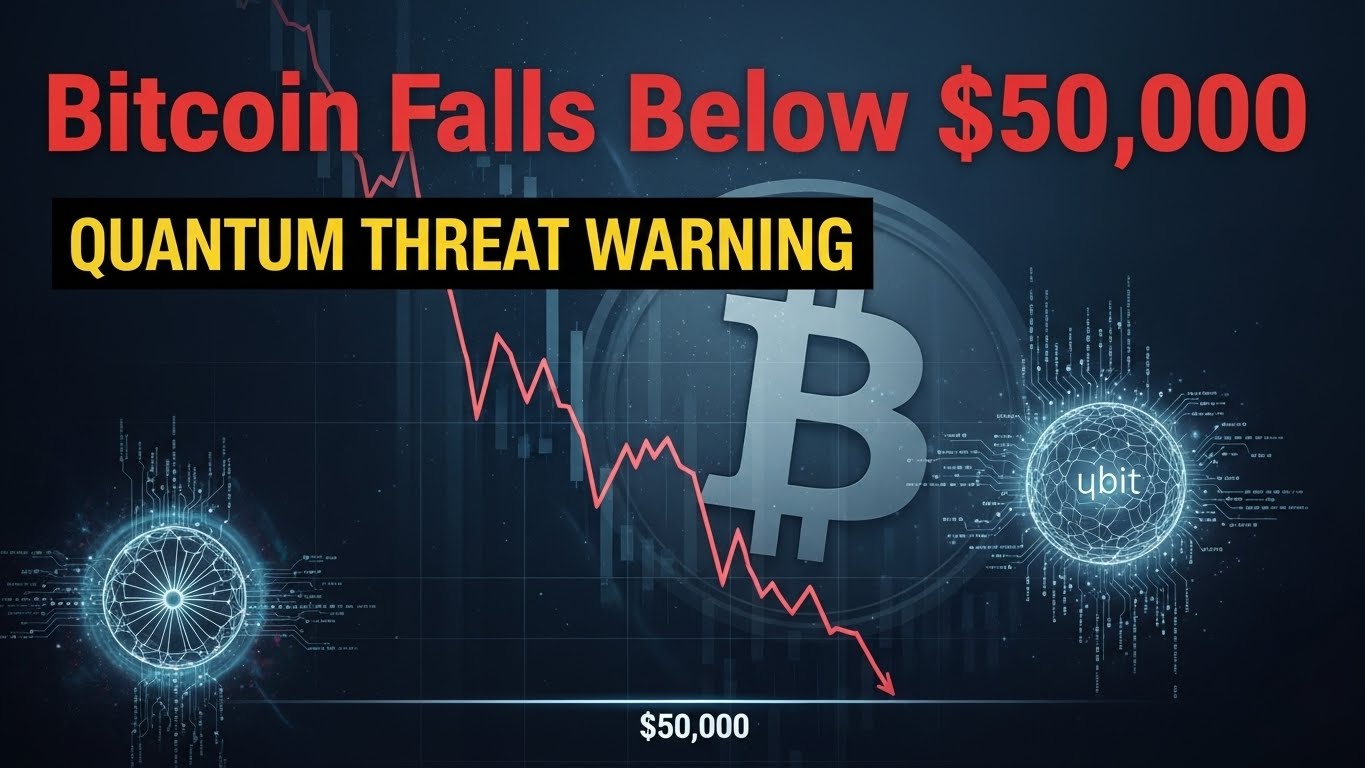

Bitcoin could fall below $50,000 due to emerging quantum computing capabilities. This stark warning has sent ripples through the digital asset community, raising urgent questions about the future security of blockchain technology and the potential vulnerability of cryptocurrency investments. As quantum computers advance at an unprecedented pace, the intersection of cutting-edge technology and Bitcoin’s fall below $50,000 becomes more than just speculation—it represents a fundamental challenge to the cryptographic foundations that secure the world’s largest cryptocurrency.
Understanding why experts like the Capriole founder are issuing such dramatic warnings requires examining the complex relationship between quantum computing advancement and cryptocurrency security protocols. The Bitcoin fall below $50,000 prediction isn’t merely about market sentiment or traditional price analysis; it reflects a deeper concern about the existential threat that sufficiently powerful quantum computers could pose to Bitcoin’s underlying security infrastructure.
Quantum Computing Threat to Bitcoin
Quantum computing represents a paradigm shift in computational capability, leveraging the principles of quantum mechanics to perform calculations that would take classical computers millennia to complete. The threat to Bitcoin and cryptocurrency security stems from quantum computers’ potential ability to break the elliptic curve cryptography that protects Bitcoin wallets and transactions.
How Bitcoin’s Cryptographic Security Works
Bitcoin relies on two primary cryptographic functions: SHA-256 for proof-of-work mining and Elliptic Curve Digital Signature Algorithm (ECDSA) for securing private keys and signing transactions. While SHA-256 enjoys relative quantum resistance, ECDSA represents a critical vulnerability. The ECDSA algorithm protects Bitcoin addresses by making it computationally infeasible for classical computers to derive private keys from public keys. However, quantum computers using Shor’s algorithm could theoretically crack this encryption, exposing billions of dollars in Bitcoin holdings to potential theft.
The Capriole founder’s prediction of Bitcoin falling below $50,000 hinges on the market’s reaction to quantum computing milestones. When quantum computers demonstrate the capability to threaten cryptographic security, panic selling could drive significant price declines. Investors holding substantial Bitcoin positions might liquidate their holdings preemptively, creating downward pressure that pushes prices below critical support levels.
Current State of Quantum Computing Development
Recent advances in quantum computing have accelerated concerns about Bitcoin’s quantum vulnerability. Tech giants including Google, IBM, and emerging quantum computing startups have made significant progress in developing quantum processors with increasing qubit counts and improved error correction. Google’s achievement of quantum supremacy in 2019 marked a watershed moment, demonstrating that quantum computers could solve specific problems faster than the world’s most powerful supercomputers.
However, the quantum computers currently available lack the scale and stability required to threaten Bitcoin’s cryptographic security. Experts estimate that breaking Bitcoin’s ECDSA encryption would require quantum computers with several million stable qubits operating with low error rates—a capability potentially decades away. Nevertheless, the exponential pace of quantum computing development means that what seems distant today could materialize sooner than anticipated.
Why the Capriole Founder Predicts Bitcoin Will Fall Below $50,000
The Capriole founder’s prediction represents more than pessimism; it reflects a calculated assessment of how quantum computing threats could impact Bitcoin price dynamics. Several interconnected factors support this bearish outlook on Bitcoin potentially falling below key psychological price levels.
Market Perception and Fear-Driven Selling
Cryptocurrency markets are notoriously sensitive to security concerns and technological vulnerabilities. When news emerges about potential threats to Bitcoin’s security infrastructure, market participants often react swiftly and decisively. The prediction of Bitcoin falling below $50,000 anticipates that quantum computing breakthroughs will trigger widespread fear, uncertainty, and doubt (FUD) among investors.
Historical precedent supports this concern. Previous security vulnerabilities, exchange hacks, and regulatory crackdowns have precipitated sharp price declines in Bitcoin and cryptocurrency markets. A credible quantum computing threat could amplify these effects exponentially, as the fundamental security of the entire Bitcoin network would be called into question rather than isolated incidents affecting individual exchanges or services.
Institutional Investment Withdrawal
Institutional investors have increasingly embraced Bitcoin as a portfolio diversification asset and inflation hedge. However, these sophisticated market participants conduct thorough risk assessments before deploying capital. The emergence of credible quantum computing threats to Bitcoin security could prompt institutional fund managers to reassess their positions and potentially exit Bitcoin holdings entirely.
The withdrawal of institutional capital would likely accelerate Bitcoin’s fall below $50,000, as large sell orders create cascading effects in relatively illiquid markets. Pension funds, hedge funds, and corporate treasuries that allocated portions of their portfolios to Bitcoin might simultaneously reduce exposure, overwhelming buyer demand and driving prices downward.
Technical Analysis and Support Levels
From a technical analysis perspective, the $50,000 price level represents a psychologically significant support zone for Bitcoin. The Capriole founder’s prediction suggests that quantum computing concerns could provide the catalyst needed to break through this support, potentially triggering stop-loss orders and creating a self-reinforcing downward spiral.
Technical traders closely monitor key support and resistance levels, and Bitcoin falling below $50,000 could signal a broader trend reversal. Chart patterns, moving averages, and momentum indicators might align to create selling pressure that compounds the fundamental concerns about quantum computing threats.
The Timeline: When Could Quantum Computers Threaten Bitcoin?
Understanding when quantum computers might pose a realistic threat to Bitcoin’s cryptographic security is crucial for assessing the validity of predictions about Bitcoin falling below $50,000. The timeline remains highly uncertain, with expert estimates ranging from ten to thirty years before quantum computers achieve sufficient capability to break Bitcoin’s encryption.
Near-Term Quantum Computing Milestones
In the near term (next five years), quantum computing development will likely focus on achieving better error correction, increasing qubit counts, and demonstrating quantum advantage in practical applications. These milestones, while significant for quantum computing generally, won’t immediately threaten Bitcoin security. However, each breakthrough will likely trigger market reactions as investors reassess the timeline for potential vulnerabilities.
The prediction of Bitcoin falling below $50,000 might materialize during this period not because quantum computers can actually break Bitcoin’s encryption, but because market sentiment shifts in anticipation of future threats. Speculative markets often price in risks well before they materialize, and cryptocurrency markets are particularly prone to forward-looking fear-based selling.
Medium-Term Developments and Bitcoin’s Response
Within the next decade, the Bitcoin development community will likely implement quantum-resistant cryptographic algorithms if quantum computing progress warrants such measures. Bitcoin’s protocol can be upgraded through community consensus, allowing the network to migrate to post-quantum cryptography before quantum computers become an existential threat.
However, upgrading Bitcoin’s protocol presents significant challenges. Achieving consensus among stakeholders, testing new cryptographic standards, and coordinating a network-wide migration requires years of preparation. The perception that Bitcoin is slow to adapt could contribute to Bitcoin’s fall below $50,000 even if the quantum threat remains distant.
Post-Quantum Cryptography: Bitcoin’s Potential Defense
The cryptocurrency community isn’t ignoring quantum computing threats. Researchers and developers are actively working on post-quantum cryptography solutions that could protect Bitcoin and other blockchain networks from quantum computer attacks.
Available Post-Quantum Cryptographic Algorithms
Several post-quantum cryptographic algorithms have been developed and are undergoing standardization by organizations like the National Institute of Standards and Technology (NIST). These algorithms, including lattice-based cryptography, hash-based signatures, and code-based cryptography, are designed to resist both classical and quantum computer attacks.
Implementing these algorithms in Bitcoin’s protocol would require significant technical work and community coordination. The transition would involve updating wallet software, modifying transaction formats, and potentially creating a hard fork if consensus cannot be achieved through backward-compatible soft fork mechanisms. The complexity and controversy surrounding such changes could contribute to market uncertainty and potentially drive Bitcoin below $50,000.
Challenges in Implementing Quantum Resistance
Adopting post-quantum cryptography isn’t as simple as flipping a switch. Post-quantum algorithms typically require larger key sizes and produce bigger signatures, increasing transaction sizes and potentially impacting Bitcoin’s scalability. These trade-offs must be carefully balanced against security benefits, and disagreements about implementation approaches could fragment the community and create multiple competing Bitcoin versions.
The possibility of contentious hard forks and protocol fragmentation represents another vector through which quantum computing concerns could drive Bitcoin’s fall below $50,000. Market participants prefer certainty and unified protocols; divisions within the Bitcoin community over quantum resistance measures could erode confidence and prompt selling.
Market Impact: How Quantum Threats Could Affect Bitcoin Price
The relationship between quantum computing development and Bitcoin price movements extends beyond direct security threats. Market psychology, investor sentiment, and competitive dynamics within the cryptocurrency ecosystem all factor into potential price impacts.
Competitive Advantage for Quantum-Resistant Cryptocurrencies
Several newer cryptocurrency projects have been designed with quantum resistance as a core feature. If quantum computing threats become more immediate, investors might rotate capital from Bitcoin into quantum-resistant alternatives, accelerating Bitcoin’s price decline. Projects like Quantum Resistant Ledger (QRL) and others explicitly marketing quantum-resistant features could capture market share at Bitcoin’s expense.
This competitive pressure could contribute significantly to Bitcoin falling below $50,000, particularly if these alternative cryptocurrencies gain traction with institutional investors seeking quantum-proof blockchain solutions. The cryptocurrency market has demonstrated willingness to rapidly shift capital between competing protocols based on perceived technological advantages.
Regulatory Responses to Quantum Threats
Governments and regulatory agencies are increasingly aware of quantum computing threats to cryptographic security. Regulatory responses to quantum vulnerabilities in Bitcoin and cryptocurrency markets could range from mandating quantum-resistant standards to restricting institutional investment in quantum-vulnerable assets.
Restrictive regulations prompted by quantum computing concerns would likely accelerate Bitcoin’s fall below $50,000 by limiting market participation and reducing liquidity. Conversely, proactive regulatory frameworks that encourage quantum resistance research might support Bitcoin’s price by increasing confidence in long-term security measures.
Expert Opinions on Bitcoin’s Quantum Vulnerability
The Capriole founder isn’t alone in raising concerns about quantum computing threats to Bitcoin. Numerous experts from cryptography, computer science, and blockchain technology have weighed in on the potential risks and timeline.
Perspectives from Cryptography Experts
Cryptography researchers generally acknowledge that sufficiently powerful quantum computers could break Bitcoin’s ECDSA encryption, but emphasize that such computers remain years or decades away. Many experts argue that the Bitcoin community has ample time to implement quantum-resistant measures before the threat becomes acute.
However, some cryptographers warn against complacency, noting that quantum computing development could accelerate unpredictably. They advocate for beginning the transition to post-quantum cryptography now rather than waiting for quantum computers to approach threatening capability. This cautious approach recognizes that protocol changes require years of development, testing, and deployment—time that might not be available if quantum computing advances faster than anticipated.
Bitcoin Developer Community Responses
The Bitcoin developer community has discussed quantum computing threats for years, with varying levels of concern. Core developers generally maintain that quantum resistance can be added to Bitcoin when necessary, but disagree about the urgency and specific implementation approaches.
Some developers argue that premature adoption of post-quantum cryptography could introduce new vulnerabilities or performance problems, advocating for a wait-and-see approach. Others push for proactive measures, suggesting that early adoption would demonstrate Bitcoin’s adaptability and reduce market uncertainty that could drive Bitcoin below $50,000.
Investment Strategies Amid Quantum Computing Concerns
For Bitcoin investors concerned about quantum computing threats and predictions of Bitcoin falling below $50,000, several strategic approaches can help manage risk while maintaining exposure to cryptocurrency markets.
Diversification Across Quantum-Resistant Assets
Investors might consider diversifying cryptocurrency holdings to include quantum-resistant blockchain projects alongside Bitcoin. This strategy hedges against the possibility that quantum computing breakthroughs trigger significant Bitcoin price declines while maintaining exposure to blockchain technology’s broader growth potential.
Diversification strategies should balance between established cryptocurrencies like Bitcoin with robust network effects and newer projects with quantum-resistant features. Overweighting speculative quantum-resistant projects carries its own risks, as many such projects lack Bitcoin’s proven track record and adoption.
Dollar-Cost Averaging and Long-Term Holding
For long-term Bitcoin believers, quantum computing concerns might represent temporary obstacles rather than existential threats. Dollar-cost averaging strategies, where investors purchase Bitcoin at regular intervals regardless of price, can mitigate timing risks associated with quantum computing news and potential price volatility.
This approach assumes that Bitcoin’s development community will successfully implement quantum resistance measures before quantum computers pose genuine threats. Investors adopting this strategy essentially bet on Bitcoin’s adaptability and the community’s technical competence to overcome quantum computing challenges.
Active Monitoring of Quantum Computing Developments
Sophisticated investors might actively monitor quantum computing developments and adjust Bitcoin positions based on specific milestones. Key indicators include increases in qubit counts, improvements in error correction, demonstrations of Shor’s algorithm at larger scales, and research publications about quantum computing timelines.
This active management approach allows investors to potentially avoid the worst price impacts if quantum computing breakthroughs materialize suddenly. However, it requires significant technical knowledge and time commitment to track relevant developments across quantum computing research, cryptocurrency security, and market dynamics.
Alternative Scenarios: Could Bitcoin Avoid Falling Below $50,000?
While the Capriole founder’s prediction emphasizes downside risks, alternative scenarios exist where Bitcoin maintains prices above $50,000 despite quantum computing concerns.
Successful Implementation of Quantum Resistance
The most optimistic scenario involves Bitcoin’s development community successfully implementing quantum-resistant cryptography well before quantum computers pose actual threats. If this transition occurs smoothly with broad community consensus, market confidence might actually increase, as Bitcoin would demonstrate adaptability and forward-looking security measures.
In this scenario, Bitcoin’s price could remain stable or even appreciate as quantum resistance becomes a competitive advantage rather than a source of anxiety. Institutional investors might increase allocations to Bitcoin once quantum resistance is proven, viewing it as a more secure long-term store of value.
Slower Quantum Computing Progress
Quantum computing development might progress more slowly than current projections suggest. Technical challenges in scaling quantum systems, maintaining qubit coherence, and implementing effective error correction could delay threatening quantum computers by decades. If the timeline extends sufficiently, Bitcoin would have ample opportunity to implement defensive measures without market panic.
This scenario assumes that current quantum computing optimism is overblown and that fundamental physics challenges will prove more difficult to overcome than anticipated. Historical precedent shows that revolutionary technologies often take longer to mature than early enthusiasts predict.
Market Resilience and Buying Opportunities
Even if quantum computing concerns temporarily drive Bitcoin below $50,000, resilient buying support from long-term holders and opportunistic investors might limit downside. The $50,000 level could prove to be a strong support zone where value investors view price declines as buying opportunities rather than reasons to panic.
This scenario recognizes that cryptocurrency markets have repeatedly demonstrated resilience in the face of negative news and FUD. Previous price crashes have consistently been followed by recoveries as fundamental adoption continues growing and technological improvements address security concerns.
Preparing for Bitcoin’s Quantum Computing Future
Regardless of whether Bitcoin falls below $50,000 due to quantum threats, the cryptocurrency community must proactively address quantum computing challenges to ensure long-term viability.
Research and Development Priorities
Increased funding for post-quantum cryptography research specific to blockchain applications is essential. The unique requirements of distributed ledger systems create constraints different from traditional cryptographic applications, necessitating tailored solutions.
Collaborative research initiatives bringing together cryptographers, quantum computing experts, and blockchain developers can accelerate progress toward practical quantum-resistant solutions for Bitcoin. Open-source development models should be leveraged to ensure transparency and broad community participation in security-critical protocol changes.
Community Consensus Building
Perhaps the greatest challenge in defending Bitcoin against quantum computing threats involves achieving community consensus about specific implementation approaches. Early and inclusive discussions about quantum resistance options can help build agreement before crisis situations emerge.
Transparent communication about quantum computing risks, realistic timeline assessments, and clear explanations of proposed solutions will be crucial for maintaining community cohesion. Avoiding polarized debates and focusing on technical merits can facilitate smoother protocol upgrades when they become necessary.
Education and Awareness
Educating Bitcoin investors and users about quantum computing threats and defense mechanisms can reduce panic-driven selling when quantum computing milestones are achieved. Informed market participants are less likely to react irrationally to news that doesn’t represent immediate threats.
Educational initiatives should emphasize both the real risks posed by quantum computing and the extensive time likely available for implementing solutions. Balanced perspectives that neither dismiss quantum threats nor exaggerate their immediacy will help markets price risks rationally.
Conclusion
For investors considering the implications of Bitcoin falling below $50,000 amid quantum threats, careful risk management and informed decision-making are essential. Understanding the technical realities of quantum computing development, monitoring progress in post-quantum cryptography, and maintaining diversified cryptocurrency portfolios can help manage risks while preserving exposure to blockchain technology’s transformative potential.
The intersection of quantum computing and Bitcoin security represents one of the most significant technological challenges facing cryptocurrency in the coming decades. Whether Bitcoin successfully implements quantum resistance and maintains its position as the leading cryptocurrency, or whether quantum threats drive Bitcoin’s fall below $50,000 and enable quantum-resistant alternatives to gain prominence, remains to be seen. What is certain is that the quantum computing era will fundamentally reshape cryptocurrency security considerations and likely trigger significant market volatility as this technological transition unfolds.
Stay informed about Bitcoin’s quantum computing developments by following cryptocurrency news sources, monitoring quantum computing research publications, and engaging with the Bitcoin developer community’s discussions about post-quantum security measures. The future of Bitcoin in a quantum computing world depends not just on technological solutions but on how effectively the community addresses these challenges and maintains market confidence through this critical transition period.
See more;Abu Dhabi Tripled Its Bitcoin Bet In Q3 Before the Crypto Market Crash