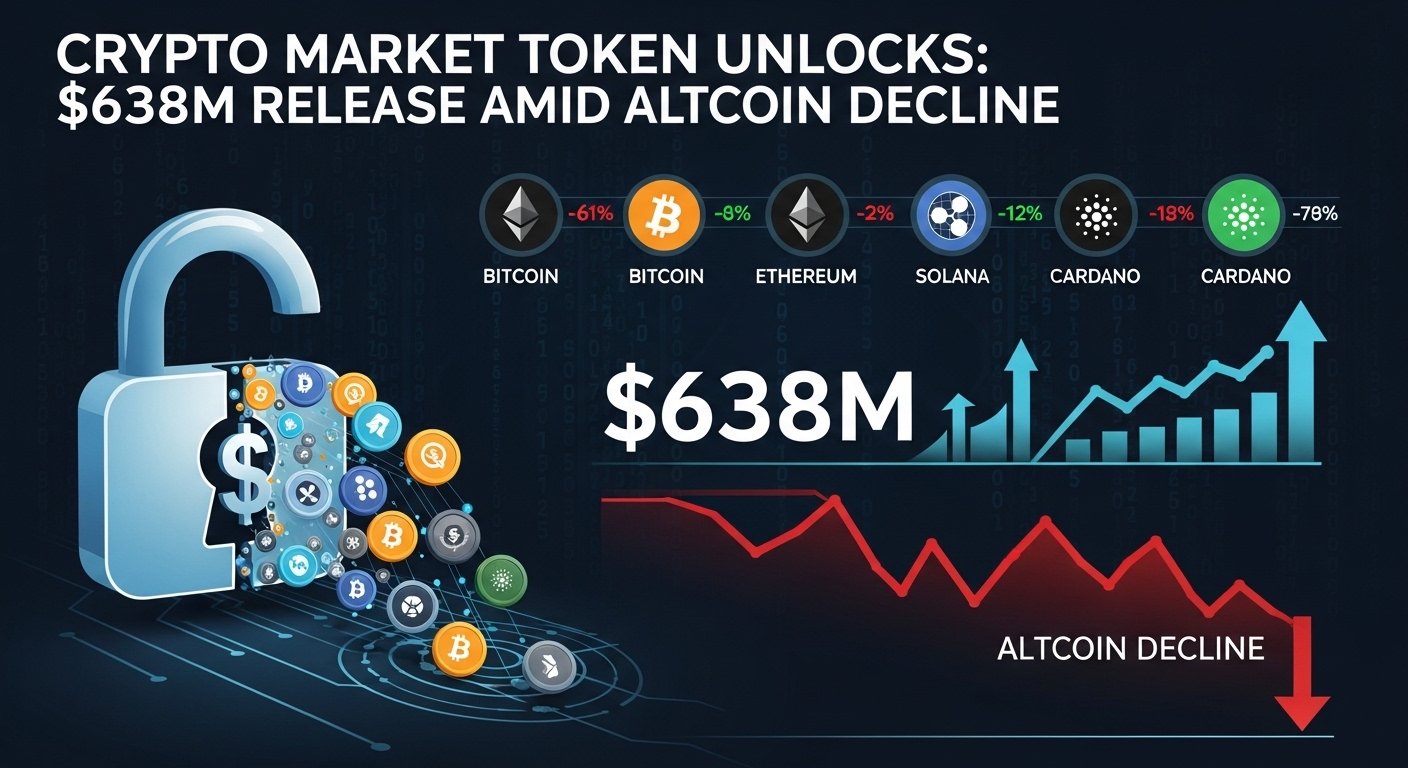

The crypto market token unlocks are set to release a staggering $638 million worth of digital assets into circulation, intensifying concerns among investors as the altcoin sector continues its relentless downward trajectory. This massive influx of newly unlocked tokens comes at a particularly precarious moment when cryptocurrency markets are already struggling with bearish sentiment, regulatory uncertainties, and declining trading volumes across major exchanges.
As the blockchain industry navigates through turbulent waters, understanding the mechanics and implications of these scheduled token releases becomes crucial for both seasoned traders and newcomers alike. The timing of these crypto market token unlocks could not be more consequential, potentially exacerbating the selling pressure that has already pushed numerous alternative cryptocurrencies to multi-month lows. Investors are now bracing for impact as vesting schedules reach critical unlock dates, threatening to flood an already oversaturated market with additional supply that could drive prices even lower.
Mechanics of Token Unlocks in Cryptocurrency Markets
The concept of crypto market token unlocks represents a fundamental aspect of tokenomics that directly influences price action, market capitalization, and investor sentiment. When blockchain projects conduct initial coin offerings, private sales, or allocate tokens to team members and early investors, these assets typically follow predetermined vesting schedules designed to prevent immediate dumping that could crash the token’s value.
These vesting mechanisms serve as protective measures, ensuring that insiders and early backers cannot immediately liquidate their holdings and exit their positions at the expense of retail investors who purchased tokens at higher valuations. However, when unlock dates arrive, the removal of these restrictions creates windows of opportunity for massive sell-offs that can devastate token prices, especially during periods when market conditions are already unfavorable.
The $638 million figure represents the cumulative value of multiple token unlock events scheduled to occur across various blockchain projects, each with its own unique circumstances and potential market ramifications. This substantial amount of newly liquid tokens entering circulation simultaneously creates a perfect storm scenario where selling pressure could overwhelm buying demand, leading to accelerated price declines across the altcoin ecosystem.
Major Token Unlock Events Contributing to the $638 Million Release
Several prominent cryptocurrency projects are approaching significant unlock milestones that contribute to the overall $638 million valuation. These scheduled releases encompass a diverse range of blockchain platforms, decentralized finance protocols, and layer-one networks that have implemented strategic vesting schedules for their native tokens.
Among the notable projects facing substantial crypto market token unlocks are established platforms with market capitalizations in the billions, as well as newer entrants that completed fundraising rounds during the previous bull market cycle. The diversity of these projects means that the selling pressure will not concentrate on a single asset but rather distribute across multiple tokens, potentially creating cascading effects throughout the broader altcoin market.
Early investors and venture capital firms who participated in seed rounds, private sales, and strategic funding events typically secured their allocations at significantly discounted prices compared to current market values. Even with the recent downturn in cryptocurrency prices, many of these locked tokens still represent substantial unrealized profits for their holders, creating strong incentives to liquidate positions as soon as vesting restrictions expire.
The Current State of Altcoin Market Bleeding and Bearish Sentiment
The altcoin market has been experiencing sustained bleeding that has eroded investor confidence and decimated portfolio values across the cryptocurrency landscape. This prolonged downturn has been characterized by consistently declining prices, shrinking market capitalizations, and exodus of retail participants who entered during periods of excessive optimism and inflated valuations.
Multiple factors have contributed to this altcoin market decline, including macroeconomic headwinds such as persistent inflation concerns, central bank monetary policies favoring traditional assets, and regulatory crackdowns in major jurisdictions that have created legal uncertainties for cryptocurrency projects and exchanges. The combination of these external pressures with internal market dynamics has created an environment where negative sentiment feeds on itself, accelerating downward price movements.
Technical analysis across major altcoins reveals disturbing patterns with most tokens trading well below critical support levels, volume indicators showing declining participation, and moving averages configured in death cross formations that historically precede extended bear markets. The psychological impact of these technical breakdowns cannot be overstated, as traders who rely on chart patterns and momentum indicators have turned increasingly bearish, adding to the selling pressure that defines current market conditions.
Impact of Token Unlock Schedule on Cryptocurrency Price Action
The relationship between crypto market token unlocks and subsequent price movements has been extensively documented through historical analysis of previous unlock events. Data consistently demonstrates that major token releases correlate with increased volatility, downward price pressure, and elevated trading volumes as newly unlocked tokens enter circulation and holders execute pre-planned exit strategies.
Market participants have learned to anticipate these unlock events, often positioning themselves ahead of scheduled releases by shorting the affected tokens or reducing their exposure to minimize potential losses. This anticipatory behavior creates a self-fulfilling prophecy where prices begin declining well before the actual unlock date as traders front-run the expected selling pressure.
The $638 million worth of token unlocks scheduled for release represents approximately several percentage points of the total altcoin market capitalization, a proportion substantial enough to move markets significantly if even a modest fraction of these newly liquid tokens finds their way to exchanges. Historical precedent suggests that unlock events of this magnitude typically result in price declines ranging from fifteen to forty percent depending on prevailing market conditions and the specific tokens involved.
Strategies for Investors Navigating Token Unlock Periods
Sophisticated investors have developed various strategies to navigate crypto market token unlocks and potentially profit from the predictable volatility these events generate. Understanding these approaches provides valuable insights for anyone holding positions in tokens approaching major unlock milestones or seeking to capitalize on the price movements that typically accompany such releases.
Conservative investors often choose to reduce or eliminate exposure to tokens with upcoming unlock events, preferring to sidestep potential losses rather than attempting to time the market or predict the magnitude of selling pressure. This approach prioritizes capital preservation over potential gains, recognizing that the risk-reward profile becomes unfavorable when significant token supplies prepare to enter circulation.
More aggressive traders may attempt to short tokens ahead of unlock dates, betting that selling pressure will overwhelm buying demand and drive prices lower. This strategy requires precise timing, substantial risk tolerance, and willingness to accept losses if unlock events fail to generate the anticipated downward momentum or if unexpected buying demand materializes to absorb the newly liquid tokens.
Opportunistic investors sometimes view token unlock events as buying opportunities, waiting for panic selling to create oversold conditions before entering positions at discounted valuations. This contrarian approach assumes that unlock-related selling represents temporary disruption rather than fundamental deterioration, and that prices will eventually recover as market conditions stabilize and the increased token supply becomes absorbed by natural demand.
Analyzing Vesting Schedules and Tokenomics Fundamentals
Understanding the structure of vesting schedules and broader tokenomics frameworks becomes essential when evaluating how crypto market token unlocks might affect specific projects and their native tokens. Different vesting mechanisms create varying levels of risk, with some designed to minimize market impact while others potentially create catastrophic selling pressure.
Linear vesting schedules release tokens gradually over extended periods, theoretically creating more manageable increases in circulating supply that markets can absorb without dramatic price disruptions. Cliff vesting arrangements, conversely, unlock large percentages of total token supplies simultaneously, creating concentrated selling pressure that overwhelms buy-side liquidity and triggers sharp price declines.
The percentage of total token supply being unlocked relative to current circulating amounts provides crucial context for assessing potential market impact. Unlocks representing single-digit percentages of existing circulation typically generate modest effects, while releases that double or triple circulating supply can devastate token prices as fundamental supply-demand dynamics shift dramatically against existing holders.
Regulatory Implications and Transparency Requirements
The regulatory landscape surrounding crypto market token unlocks continues evolving as securities authorities worldwide grapple with classification questions and investor protection concerns related to token vesting schedules and unlock events. Jurisdictions vary significantly in their approaches, creating compliance challenges for projects with global token holder bases and cross-border operations.
Transparency requirements increasingly mandate that cryptocurrency projects provide detailed disclosure of vesting schedules, unlock dates, and the identities of major token holders subject to lock-up agreements. These disclosure obligations aim to level the information playing field between insiders who possess detailed knowledge of upcoming unlocks and retail investors who may lack access to this critical data.
Securities regulators in several major markets have issued guidance suggesting that tokens sold with extensive vesting restrictions may constitute securities offerings subject to registration requirements and ongoing reporting obligations. This regulatory treatment creates additional compliance burdens for projects and potentially exposes them to enforcement actions if token sales and subsequent unlocks violate applicable securities laws.
Historical Analysis of Major Token Unlock Events and Market Reactions
Examining previous token unlock events provides valuable lessons about typical market reactions and helps investors calibrate expectations regarding the current $638 million unlock wave. Historical data reveals consistent patterns while also highlighting exceptions that demonstrate the context-dependent nature of unlock impacts.
One notable case study involved a prominent layer-one blockchain that experienced a thirty-seven percent price decline in the two weeks following a major unlock that released approximately eighteen percent of total token supply. The selling pressure overwhelmed existing demand, creating a cascading effect as stop-loss orders triggered and panic selling intensified the downward momentum.
Conversely, certain crypto market token unlocks have generated minimal price impact when occurring during strong bull markets with abundant liquidity and enthusiastic buying demand. These exceptions prove that market conditions surrounding unlock events matter tremendously, with the same unlock percentage potentially creating vastly different outcomes depending on prevailing sentiment and macroeconomic factors.
Relationship Between Token Unlocks and Project Development Milestones
The timing of crypto market token unlocks often correlates with project development phases, as vesting schedules typically align with roadmap achievements and operational milestones. Understanding these relationships helps investors distinguish between unlocks that reward past contributions versus those that might signal waning team commitment or shifting priorities.
Early-stage unlocks for team members and developers usually occur after initial product launches or significant technical achievements, theoretically ensuring that recipients have delivered value before gaining liquidity. However, these unlocks can create perverse incentives if team members prioritize token sales over continued project development, potentially abandoning initiatives once they secure profits from their vested allocations.
Investor unlocks from private funding rounds typically follow separate schedules designed to prevent immediate liquidation while allowing backers to realize returns within reasonable timeframes. The tension between investor liquidity preferences and project stability creates challenging dynamics, with aggressive unlock schedules potentially undermining long-term value creation in favor of short-term exit opportunities.
Technical Market Analysis and Token Unlock Correlation
Technical analysts have developed specialized methodologies for trading around crypto market token unlocks, combining traditional chart analysis with unlock-specific indicators and volume patterns. These approaches attempt to quantify selling pressure, identify optimal entry and exit points, and manage risk during periods of elevated volatility surrounding major token releases.
Volume analysis becomes particularly crucial when evaluating token unlock events, as unusual volume spikes often precede unlock dates when insiders begin positioning and informed traders adjust their holdings. Comparing current volume patterns to historical averages during previous unlock cycles helps identify whether selling pressure is materializing as expected or if unexpected buying demand might offset newly liquid token supplies.
Support and resistance levels assume heightened importance during unlock periods, as these technical thresholds often determine whether selling pressure triggers cascading declines or whether buying demand stabilizes prices at predictable levels. Traders closely monitor these levels, placing strategic orders to either capitalize on breakdowns or accumulate positions at discounted valuations if support holds.
Risk Management Approaches for Token Unlock Exposure
Implementing robust risk management becomes paramount when holding positions in tokens approaching significant crypto market token unlocks. The elevated uncertainty and potential for dramatic price movements demand disciplined approaches that protect capital while maintaining exposure to potential upside if unlocks generate less selling pressure than anticipated.
Position sizing adjustments represent a fundamental risk management tool, with many investors reducing their allocation percentages in tokens facing imminent unlocks to levels that align with their risk tolerance and portfolio objectives. This approach acknowledges unlock risks while maintaining some exposure to capture potential gains if worst-case scenarios fail to materialize.
Stop-loss orders strategically placed below key support levels provide automatic downside protection, ensuring that positions exit if selling pressure breaches critical thresholds. However, traders must calibrate these stops carefully to avoid premature exits from temporary volatility while still protecting against sustained declines that could erode substantial capital.
Future Outlook for Token Unlock Dynamics and Market Evolution
The cryptocurrency industry continues refining approaches to crypto market token unlocks as projects learn from past mistakes and investors become increasingly sophisticated in their analysis of vesting schedules and unlock implications. This evolution promises to reshape tokenomics design and potentially reduce the market disruption associated with major token releases.
Innovative vesting mechanisms that incorporate performance milestones, market condition triggers, and gradual release schedules represent emerging best practices that aim to align stakeholder incentives while minimizing adverse market impacts. These advanced approaches acknowledge that crude time-based vesting creates misaligned incentives and predictable selling pressure that sophisticated traders exploit at the expense of less informed participants.
Market infrastructure improvements including enhanced transparency requirements, standardized disclosure formats, and automated unlock calendars are making information about upcoming token unlock events more accessible to retail investors. This democratization of previously insider-exclusive knowledge helps level the playing field and potentially reduces the information asymmetries that have traditionally advantaged sophisticated participants.
Comparative Analysis of Token Unlock Practices Across Blockchain Ecosystems
Different blockchain ecosystems have adopted varying philosophies regarding crypto market token unlocks and vesting schedule design, creating instructive comparisons that reveal the strategic considerations underlying these critical tokenomics decisions. Examining these differences provides insights into best practices and potential pitfalls that projects should consider when structuring their token distribution mechanisms.
Ethereum-based projects typically implement relatively conservative vesting schedules with extended lock-up periods for team tokens and gradual release mechanisms designed to minimize market disruption. This cautious approach reflects lessons learned from early ICO-era projects that experienced catastrophic price collapses when team members dumped newly unlocked tokens.
Alternative layer-one blockchains have experimented with more aggressive unlock schedules, sometimes releasing substantial token percentages shortly after mainnet launch in attempts to quickly distribute governance power and achieve decentralization objectives. These approaches create elevated short-term price risks but potentially accelerate the timeline for achieving genuinely decentralized token holder bases.
Integration of Token Unlock Data into Investment Decision Frameworks
Sophisticated cryptocurrency investors increasingly integrate crypto market token unlocks analysis into comprehensive investment frameworks that evaluate projects across multiple dimensions. This holistic approach recognizes that unlock schedules represent just one factor among many that determine long-term value creation potential and appropriate position sizing.
Fundamental analysis incorporating unlock schedules examines the percentage of total supply subject to upcoming releases, the identities and incentives of major token holders, and the historical behavior of similar projects during comparable unlock events. This research helps investors distinguish between manageable unlock events and potentially catastrophic releases that justify avoiding or shorting the affected tokens.
Quantitative models attempt to predict price impacts from token unlock events using regression analysis, machine learning algorithms, and statistical techniques that identify correlations between unlock characteristics and subsequent price movements. While these models cannot perfectly predict outcomes, they provide probabilistic frameworks that inform position sizing and risk management decisions.
The Role of Market Makers and Liquidity Providers During Token Unlocks
Market makers and institutional liquidity providers play crucial roles in moderating the price impact of crypto market token unlocks, sometimes absorbing substantial selling pressure and providing bid-side support that prevents panic-driven cascades. Understanding their motivations and operational constraints helps investors anticipate likely market reactions to major unlock events.
Professional market makers typically increase their activity around known unlock dates, widening spreads to compensate for elevated inventory risks and deploying additional capital to capture arbitrage opportunities created by temporary price dislocations. Their participation provides essential liquidity that facilitates orderly markets even when substantial token quantities enter circulation.
However, market makers also protect their own interests and will step aside if selling pressure exceeds their risk capacity or threatens to generate losses that outweigh their compensation for providing liquidity. This self-protective behavior means that truly massive token unlock events can overwhelm even professional liquidity provision, leaving markets vulnerable to dramatic price swings when natural buying demand proves insufficient.
Psychological Factors Influencing Investor Behavior Around Token Unlocks
Behavioral economics provides valuable frameworks for understanding the psychological dynamics that influence investor decision-making surrounding crypto market token unlocks. These psychological factors often create predictable patterns that sophisticated traders exploit while less experienced participants fall victim to emotional decision-making and cognitive biases.
Anchoring bias causes investors to fixate on previous price levels when evaluating whether to hold or sell tokens facing upcoming unlocks, often resulting in unrealistic expectations about price stability and resistance to acknowledging changed fundamentals. This bias creates denial-driven holding behavior that exacerbates losses when unlock-driven selling pressure eventually overwhelms support levels.
Loss aversion psychology makes investors disproportionately fearful of crystallizing losses, sometimes causing them to hold positions through token unlock events even when rational analysis suggests exit strategies would minimize damage. This emotional attachment to avoiding realized losses creates opportunities for rational actors who dispassionately evaluate risk-reward profiles and act accordingly.
Conclusion
The impending release of $638 million worth of crypto market token unlocks represents a critical juncture for the cryptocurrency ecosystem as it navigates continuing altcoin market challenges and bearish sentiment that has persisted through recent months. Investors who understand the mechanics, historical precedents, and strategic implications of these unlock events position themselves to weather the storm and potentially capitalize on opportunities that emerge from the inevitable volatility.
Successful navigation of this token unlock wave requires disciplined risk management, thorough research into specific project vesting schedules, and a realistic assessment of how additional token supply will interact with current demand dynamics. Those who dismiss these unlocks as irrelevant or assume that markets have already priced in the anticipated selling pressure risk substantial losses as newly liquid tokens flood exchanges and test the resilience of buy-side support.
As the cryptocurrency industry matures, the impact of crypto market token unlocks will likely moderate through improved vesting design, enhanced transparency, and more sophisticated market infrastructure. Until that evolution completes, however, investors must remain vigilant about upcoming unlock events and incorporate this analysis into comprehensive investment frameworks that acknowledge both opportunities and risks inherent in these predictable supply expansions.
See more; LayerZero & Canton Pump as Bitcoin Consolidates – Why?