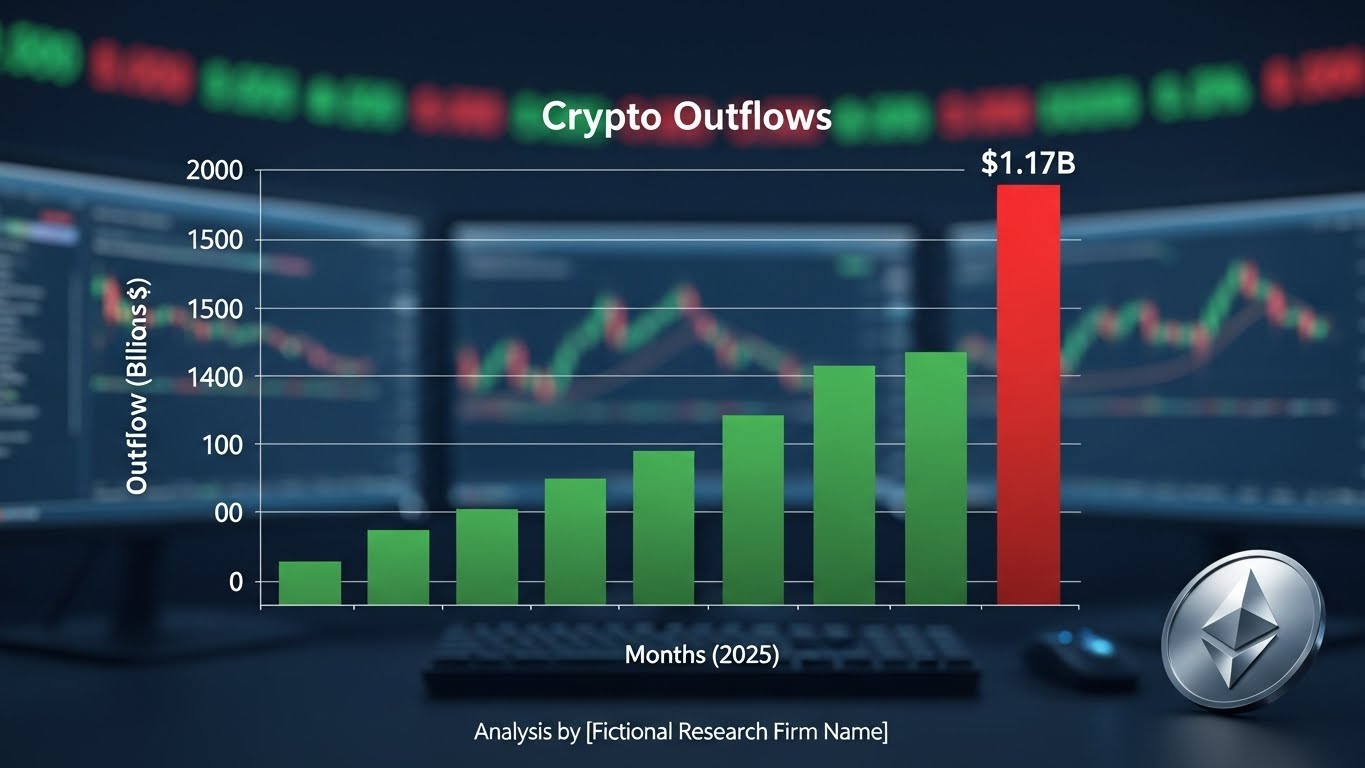

Crypto outflows hit $1.17B, marking one of the most substantial capital withdrawals in recent months. This massive exodus from digital asset investment products comes at a time when the United States markets face considerable headwinds, creating uncertainty among investors worldwide. Despite this concerning trend of capital flight from traditional cryptocurrency holdings, an intriguing paradox has emerged within the broader digital asset ecosystem. While billions flee Bitcoin-focused products and traditional crypto vehicles, altcoins continue to attract capital, suggesting a sophisticated shift in investor sentiment rather than a wholesale abandonment of the cryptocurrency sector. This divergence presents a fascinating case study in market psychology and highlights the evolving maturity of crypto markets.
Scale of Recent Cryptocurrency Capital Flows
The magnitude of recent digital asset outflows cannot be understated when examining the current state of cryptocurrency markets. When crypto outflows hit $1.17B within a compressed timeframe, it represents more than just numbers on a spreadsheet. This figure reflects genuine concern among institutional investors, retail traders, and fund managers about the immediate trajectory of cryptocurrency valuations. Historical analysis reveals that outflows of this magnitude typically coincide with broader macroeconomic uncertainty or specific sector challenges that shake investor confidence at fundamental levels.
The composition of these outflows tells an important story about where anxiety concentrates within the cryptocurrency ecosystem. Bitcoin investment products bore the brunt of redemptions, with exchange-traded products and institutional vehicles experiencing the heaviest withdrawal activity. This concentration suggests that investors harbor specific concerns about the leading cryptocurrency rather than blanket pessimism about blockchain technology or digital assets as a conceptual category. The distinction matters significantly when forecasting future market movements and understanding the underlying drivers of current cryptocurrency market volatility.
Breaking Down the Geographic Distribution of Capital Flight
Not all markets experienced equal pressure during this period when crypto outflows hit $1.17B across global investment products. United States-based cryptocurrency funds witnessed disproportionate redemption activity, accounting for approximately seventy percent of total outflows during the measured period. This geographic concentration points toward region-specific factors influencing investor behavior beyond simple price action or technical chart patterns that would affect global markets uniformly.
European cryptocurrency investment vehicles experienced moderate outflows, though substantially less severe than their American counterparts. Asian markets, particularly those in Hong Kong and Singapore, demonstrated relative resilience with only marginal net outflows or, in certain cases, modest positive inflows. This geographic divergence underscores how regulatory environments, taxation policies, and regional economic conditions create distinct investment climates even within the globally connected cryptocurrency marketplace.
U.S. Markets Face Mounting Pressure Amid Regulatory Uncertainty
The United States cryptocurrency sector confronts multiple concurrent challenges that partially explain why crypto outflows hit $1.17B, predominantly from American investment products. Regulatory ambiguity continues casting long shadows over institutional participation, with major financial entities hesitating to deepen cryptocurrency exposure amid unclear compliance frameworks. Recent enforcement actions against prominent cryptocurrency platforms have amplified caution, causing portfolio managers to reassess risk tolerances and exposure limits across digital asset allocations.
Traditional equity markets in the United States have simultaneously experienced their own turbulence, creating a correlation effect that impacts cryptocurrency holdings. When stock portfolios decline, investors often liquidate alternative assets to meet margin calls, rebalance portfolios, or simply raise cash during periods of financial stress. This mechanical selling pressure compounds genuine cryptocurrency concerns, creating downward spirals that feed on themselves through algorithmic trading and automated risk management systems.
The Federal Reserve’s Monetary Policy Impact on Digital Assets
Central bank policy decisions reverberate powerfully through cryptocurrency markets despite the sector’s philosophical foundation in decentralized finance. When the Federal Reserve maintains elevated interest rates to combat persistent inflation, risk assets, including cryptocurrencies, face systemic headwinds. Higher yields on government bonds and money market instruments make the speculative, non-yielding nature of most cryptocurrencies comparatively less attractive from a portfolio construction perspective.
The relationship between monetary tightening and cryptocurrency capital flows operates through multiple transmission mechanisms. Institutional investors operate under strict mandates requiring specific risk-adjusted return profiles. When safer assets offer compelling yields, the hurdle rate for riskier investments rises accordingly. Cryptocurrencies must demonstrate substantially higher expected returns to justify allocation, and during periods of price stagnation or decline, they fail this threshold, triggering systematic redemptions that contribute to situations where crypto outflows hit $1.17B or more.
The Altcoin Anomaly: Why Alternative Cryptocurrencies Attract Investment Despite Broader Outflows
While Bitcoin and certain major cryptocurrencies hemorrhage capital, altcoins continue to attract capital in a pattern that initially appears contradictory but reveals sophisticated market segmentation upon closer examination. Investors distinguish between different cryptocurrency categories based on utility, technological innovation, and growth potential rather than treating all digital assets as interchangeable speculative vehicles. This maturation of investment thesis development marks a significant evolution from earlier market cycles when correlation approached near-perfect levels across all cryptocurrency assets.
Specific altcoin investments receiving positive flows cluster around particular technological narratives and use cases that capture investor imagination. Layer-two scaling solutions built atop Ethereum attract capital as they address fundamental blockchain limitations around transaction throughput and cost efficiency. Decentralized finance protocols demonstrating genuine revenue generation and economic sustainability draw investment from those seeking cash-flow-producing crypto assets rather than pure price appreciation speculation.
Technological Innovation Driving Selective Altcoin Inflows
The divergence between overall digital asset outflows and specific altcoin strength stems partly from breakthrough technological developments that certain projects achieved recently. Advances in zero-knowledge proof systems enable privacy-preserving transactions at scale, attracting capital toward cryptocurrencies implementing these cutting-edge cryptographic techniques. Interoperability solutions that facilitate seamless asset transfers across disparate blockchain networks address longstanding fragmentation problems, making related tokens attractive to investors betting on multi-chain futures.
Real-world asset tokenization represents another category where altcoins continue to attract capital despite broader market weakness. Projects facilitating the representation of physical assets like real estate, commodities, or financial instruments on blockchain infrastructure tap into enormous addressable markets beyond purely digital native applications. Institutional investors particularly gravitate toward these use cases as they bridge traditional finance with blockchain technology in comprehensible ways that fit existing investment frameworks and regulatory structures.
Gaming and Metaverse Tokens Maintain Momentum
Entertainment-focused cryptocurrencies connected to gaming ecosystems and virtual world economies demonstrate resilience even as crypto outflows hit $1.17B across traditional investment products. The logic underlying continued investment in this category relates to fundamental demand from actual users rather than pure financial speculation. When gaming platforms accumulate millions of active users who transact in native tokens for in-game purchases, collectibles, and virtual real estate, these tokens develop intrinsic utility value independent of broader cryptocurrency market sentiment.
Major gaming companies exploring blockchain integration lend credibility to this sector, attracting capital from venture funds and strategic investors, positioning for potential mainstream adoption. Unlike purely speculative tokens lacking real-world use cases, gaming-related cryptocurrencies can point toward measurable metrics like daily active users, transaction volumes, and developer activity that provide fundamental valuation anchors beyond technical chart analysis or momentum trading patterns.
Institutional Investor Behavior During Cryptocurrency Market Volatility
The composition of investors driving the situation where crypto outflows hit $1.17B reveals important insights about institutional cryptocurrency adoption patterns and their response mechanisms during market stress. Large asset managers operate under fiduciary duties requiring systematic risk management, making them particularly sensitive to volatility spikes and drawdown thresholds. When cryptocurrency portfolios breach predetermined risk parameters, automated selling protocols activate regardless of longer-term conviction about digital asset potential.
Pension funds and endowments, which increased cryptocurrency allocations significantly during previous bull markets, reassess these positions during extended price weakness. Unlike high-net-worth individuals or family offices with greater flexibility, institutional investors face governance structures requiring regular reviews and justifications for alternative asset exposures. Sustained underperformance triggers redemption pressures from beneficiaries and oversight committees, contributing to the substantial cryptocurrency capital flows exiting traditional investment vehicles.
Hedge Funds Employ Sophisticated Strategies Amid Turbulence
Cryptocurrency-focused hedge funds demonstrate more nuanced behavior than passive investment products during periods when crypto outflows hit $1.17B across broader markets. These specialized managers often employ relative value strategies, going long on cryptocurrencies showing strength while shorting weaker assets, creating market-neutral positions that profit from dispersion rather than directional moves. This approach explains how altcoins continue to attract capital even within hedge fund portfolios that simultaneously reduce overall cryptocurrency exposure.
Quantitative trading firms operating in cryptocurrency markets provide liquidity and dampen volatility through continuous market-making activities, though they quickly withdraw during extreme stress events when bid-ask spreads widen dramatically. Their risk management systems force position reductions when volatility exceeds certain thresholds, potentially amplifying selling pressure during cascading liquidation events that contribute to massive outflow figures.
Bitcoin Dominance Patterns and Market Cycle Implications
The concentration of outflows within Bitcoin investment products, while altcoins continue to attract capita,l creates interesting implications for the Bitcoin dominance metric that measures the leading cryptocurrency’s market capitalization percentage relative to the total cryptocurrency market. Historically, declining Bitcoin dominance during bear markets signaled speculative excess in alternative cryptocurrencies, often preceding further market deterioration. However, current patterns suggest potentially different dynamics warranting careful interpretation.
When investors differentiate between Bitcoin as primarily a store of value versus altcoins offering specific utility functions or technological innovations, dominance fluctuations reflect portfolio reallocation rather than indiscriminate speculation. This maturation suggests that situations where crypto outflows hit $1.17B from Bitcoin products but altcoins receive inflows might indicate sophisticated capital rotation rather than dangerous speculation reminiscent of previous bubble periods.
Historical Context for Current Outflow Magnitudes
Comparing recent outflows to historical precedents provides perspective on whether current digital asset outflows represent genuine crisis conditions or routine market corrections within normal volatility ranges for cryptocurrency markets. The period surrounding the collapse of major cryptocurrency exchanges in previous years witnessed outflows exceeding three billion dollars within a single week, accompanied by systemic contagion fears and liquidity crises across multiple platforms simultaneously.
By this standard, while crypto outflows hit $1.17B represents a substantial capital withdrawal, it remains within ranges experienced during previous correction phases that ultimately resolved without permanent damage to the cryptocurrency market infrastructure. This context should temper panic while acknowledging legitimate concerns that drove redemptions. Markets process information through price discovery mechanisms, and outflows represent part of this continuous recalibration process.
Ethereum’s Unique Position in Current Market Dynamics
Ethereum capital inflows present particularly interesting dynamics during the period when crypto outflows hit $1.17B across broader cryptocurrency markets. The second-largest cryptocurrency by market capitalization occupies a unique middle ground between Bitcoin’s store-of-value narrative and smaller altcoins’ specific use-case focuses. Ethereum functions simultaneously as a commodity asset, a technology platform, and the foundation layer for vast ecosystems of decentralized applications, creating diverse investor constituencies with different motivations and time horizons.
Recent network upgrades improving Ethereum’s scalability and reducing energy consumption through proof-of-stake consensus mechanisms attracted fresh capital from environmentally conscious investors and institutions previously deterred by proof-of-work mining’s carbon footprint. Staking functionality enabling Ethereum holders to earn yields through network validation provides cash-flow characteristics that appeal to income-focused investors seeking alternatives to traditional fixed-income securities in challenging rate environments.
Layer-Two Solutions Building on Ethereum Infrastructure
Much of the capital flowing toward altcoins during this period when crypto outflows hit $1.17B from traditional products actually remains within the broader Ethereum ecosystem through layer-two scaling solutions. These networks, including optimistic rollups and zero-knowledge rollup technologies, process transactions off the main Ethereum blockchain while inheriting its security guarantees, offering substantially lower fees and higher throughput that enable consumer-scale applications.
Investment products focused on tokens associated with these layer-two networks received positive flows as investors bet on their growing transaction volumes and ecosystem development. This represents sophisticated thesis development where capital rotates within cryptocurrency sectors rather than completely exiting digital assets, explaining the apparent contradiction between overall digital asset outflows and specific categories showing strength.
Decentralized Finance Protocols Weather Broader Market Storms
Decentralized finance platforms demonstrated remarkable resilience during the period when crypto outflows hit $1.17B, with certain protocols actually experiencing increased total value locked despite declining cryptocurrency prices. This counterintuitive pattern reflects growing appreciation for protocols generating genuine economic activity and revenue rather than relying purely on token price appreciation. Lending platforms facilitating billions in loans, decentralized exchanges processing substantial trading volumes, and derivatives protocols enabling sophisticated hedging strategies all produce measurable cash flows that support fundamental valuations.
The sustainability of these protocols during market stress tests their underlying economic models and separates genuinely useful infrastructure from speculative projects lacking real demand. Investors increasingly differentiate between categories, explaining how altcoins continue to attract capital selectively even during broader market weakness. Protocols demonstrating resilient usage metrics and revenue generation through multiple market cycles attract long-term capital from investors building conviction about decentralized finance’s permanent role in global financial infrastructure.
Stablecoin Dynamics and Their Market Implications
Stablecoin circulation patterns provide important context for understanding the situation where crypto outflows hit $1.17B from investment products. When investors redeem stablecoins for fiat currency, removing them entirely from cryptocurrency ecosystems, it signals genuine capital flight and risk-off sentiment. Conversely, when cryptocurrency sales convert into stablecoins that remain on exchanges or in decentralized finance protocols, it suggests tactical positioning rather than permanent exit, with capital waiting on the sidelines for perceived opportunities.
Recent data indicate that while cryptocurrency market volatility triggered substantial Bitcoin and Ethereum sales, stablecoin supplies remained relatively stable or even increased slightly. This pattern suggests that capital exiting specific cryptocurrencies is often repositioned within the broader digital asset ecosystem rather than completely leaving, supporting the thesis that current outflows represent rotation and repositioning rather than wholesale abandonment of cryptocurrency as an asset class.
Global Regulatory Developments Shaping Capital Flows
International regulatory evolution significantly influences patterns where crypto outflows hit $1.17B in certain jurisdictions, while other regions attract capital. European Union markets implementing comprehensive cryptocurrency regulatory frameworks through MiCA legislation create cleaner operating environments that potentially attract institutional capital previously deterred by regulatory ambiguity. Early indications suggest European cryptocurrency investment products are experiencing more modest outflows than their American counterparts, with certain vehicles even recording net inflows during the measured period.
Asian regulatory approaches vary dramatically across jurisdictions, with Hong Kong pursuing cryptocurrency hub ambitions through favorable licensing regimes for exchanges and asset managers while maintaining robust consumer protection frameworks. These efforts aim to capture capital flows that might otherwise gravitate toward less regulated offshore venues, creating competition between financial centers for cryptocurrency industry dominance that ultimately benefits the sector through improved infrastructure and institutional participation.
Taxation Policy Impact on Investor Behavior
Tax treatment of cryptocurrency transactions powerfully influences investment decisions and capital allocation patterns that contribute to situations where crypto outflows hit $1.17B during specific periods. Jurisdictions treating cryptocurrency sales as capital gains events create tax-loss harvesting incentives toward year-end, potentially explaining seasonal outflow patterns beyond fundamental market drivers. Sophisticated investors strategically realize losses to offset gains in other portfolio areas, creating mechanical selling pressure disconnected from views about cryptocurrency’s long-term potential.
Conversely, certain jurisdictions offering favorable tax treatment for long-term cryptocurrency holdings or exempting specific transaction types from taxation attract capital seeking regulatory arbitrage opportunities. This regulatory fragmentation creates complex incentive structures influencing global cryptocurrency capital flows in ways that extend beyond pure investment thesis considerations.
Technical Analysis Perspectives on Current Market Structure
From technical analysis viewpoints, the period when crypto outflows hit $1.17B coincided with Bitcoin testing critical support levels that historically represented major inflection points in previous market cycles. When prices approach these psychologically significant thresholds, algorithmic trading systems and technical traders execute predetermined strategies that can amplify moves in either direction, creating self-fulfilling prophecies where support levels hold or break based partly on collective belief in their importance.
Chart patterns forming during this period suggest potential bottoming formations in certain cryptocurrencies even as digital asset outflows continue from investment products. Divergences between price action and momentum indicators sometimes precede trend reversals, though distinguishing genuine signals from false patterns requires careful analysis and risk management. Technical traders employ position sizing and stop-loss disciplines to navigate this uncertainty, contributing to the overall flow dynamics through their systematic approaches.
On-Chain Metrics Providing Fundamental Insights
Blockchain analytics examining transaction patterns, wallet distributions, and network activity metrics offer fundamental perspectives beyond price charts when evaluating situations where crypto outflows hit $1.17B from investment products. Metrics showing long-term holders accumulating during price weakness while short-term speculators exit suggest smart money positioning for eventual recovery, though these patterns require extended time horizons to validate.
Network activity metrics like daily active addresses, transaction volumes, and developer commit activity provide insights into underlying blockchain health independent of short-term price movements. When these fundamental indicators remain stable or improve even as cryptocurrency market volatility triggers outflows from investment products, it suggests that selling pressure stems from financial market dynamics rather than deteriorating protocol fundamentals.
Future Outlook and Strategic Implications for Investors
Navigating markets where crypto outflows hit $1.17B while altcoins continue to attract capital requires sophisticated frameworks distinguishing between different investment horizons and objectives. Long-term investors focused on cryptocurrency’s potential to transform global financial infrastructure might view current weakness as accumulation opportunities, particularly in projects demonstrating technological innovation and real-world adoption progress. This approach requires conviction withstanding substantial volatility and extended periods of underperformance before potential validation.
Tactical traders operate with shorter time horizons, seeking to profit from momentum shifts and technical patterns regardless of longer-term fundamental views. For these participants, current market conditions create opportunities in volatility itself through derivatives strategies, arbitrage between different cryptocurrency exchanges or investment vehicles, and relative value trades between stronger and weaker digital assets.
Portfolio Construction Strategies for Cryptocurrency Exposure
Institutional investors reconsidering cryptocurrency allocations after experiencing the period when crypto outflows hit $1.17B should evaluate whether redemptions stemmed from strategic asset allocation decisions or tactical responses to volatility. If portfolios initially included cryptocurrencies for diversification benefits and exposure to technological innovation, short-term price movements arguably shouldn’t trigger the complete elimination of positions absent fundamental thesis changes.
Rebalancing approaches that systematically adjust cryptocurrency exposure based on price movements rather than discretionary timing decisions help investors avoid emotional decision-making during volatile periods. When cryptocurrencies decline substantially, mechanical rebalancing frameworks actually increase allocations back toward target weights, forcing disciplined buying during weakness that feels psychologically uncomfortable but historically generated attractive long-term returns across various asset classes.
Conclusion
The complex dynamics where crypto outflows hit $1.17B from traditional investment products while altcoins continue to attract capital in specific categories illustrate the cryptocurrency market’s evolving sophistication and segmentation. These patterns reflect investors differentiating between digital assets based on technological merit, utility, and fundamental economics rather than treating all cryptocurrencies as interchangeable speculative vehicles. This maturation represents healthy market development even as it creates short-term volatility and uncertainty.
Understanding these nuanced capital flow patterns requires moving beyond simplistic narratives about cryptocurrency broadly succeeding or failing. Instead, the sector increasingly resembles traditional markets with winners and losers determined by execution, innovation, and market fit rather than rising tides lifting all boats indiscriminately. Investors navigating this environment must develop sophisticated analytical frameworks evaluating individual projects while monitoring broader macroeconomic conditions affecting risk asset valuations globally.
For those seeking to understand or participate in cryptocurrency markets during periods of significant digital asset outflows and selective altcoin investments, maintaining disciplined research processes, appropriate risk management, and realistic time horizons remains essential. The technology underlying blockchain and cryptocurrency continues advancing regardless of short-term price volatility, suggesting that patient capital focused on fundamental value creation may ultimately benefit from current market dislocations.
See more; Bitcoin Weekly Forecast: BTC Dips Below $90K