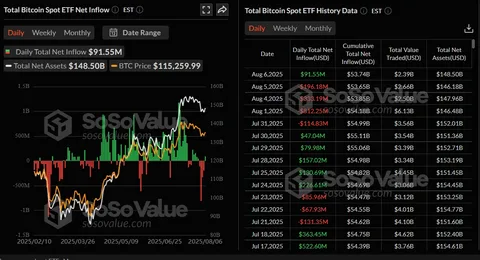

The Bitcoin price forecast has taken a concerning turn as the flagship cryptocurrency struggles to maintain momentum below the critical $90,000 threshold. Market participants are closely monitoring the convergence of two significant headwinds: persistent outflows from Bitcoin exchange-traded funds and an approaching options expiry that could inject further volatility into an already uncertain market. As institutional investors reassess their positions and traders brace for potential price swings, understanding the forces shaping Bitcoin’s near-term trajectory has never been more crucial for anyone with exposure to digital assets.
The current market dynamics reflect a departure from the euphoric sentiment that previously propelled BTC price prediction models toward six-figure valuations. Instead, Bitcoin finds itself trapped in a consolidation phase where bearish pressure from ETF redemptions collides with technical resistance levels, creating a precarious situation that demands careful analysis from both retail and institutional market participants.
Understanding the Current Bitcoin Market Landscape
The cryptocurrency market analysis reveals a complex interplay of factors contributing to Bitcoin’s current price stagnation. After reaching unprecedented heights earlier in the cycle, Bitcoin has entered a phase characterized by reduced buying momentum and increased caution among investors. The psychological barrier of $90,000 has proven particularly stubborn, with multiple attempts to breach this level resulting in swift rejections that have shaken trader confidence.
Market structure analysis indicates that Bitcoin is currently trading within a defined range, with support established around the $85,000 level and resistance firmly entrenched near $92,000. This consolidation period follows a broader pattern observed in previous Bitcoin cycles, where periods of explosive growth are typically followed by extended phases of price discovery and accumulation. However, the unique challenges presented by current market conditions suggest that this consolidation may extend longer than many participants initially anticipated.
The broader macroeconomic environment continues to exert significant influence over digital asset forecast models. Federal Reserve policy decisions, inflation data releases, and shifting expectations regarding interest rate trajectories all contribute to the risk appetite that ultimately determines capital flows into Bitcoin and other cryptocurrencies. As traditional markets grapple with their own uncertainties, Bitcoin’s correlation with risk assets has become increasingly pronounced, limiting its ability to function as the uncorrelated hedge that many advocates have long championed.
Bitcoin ETF Outflows: A Critical Pressure Point
The persistent Bitcoin ETF outflows represent one of the most significant headwinds currently facing the cryptocurrency market. Since the approval and launch of spot Bitcoin ETFs in early 2024, these investment vehicles have fundamentally altered the landscape of institutional Bitcoin exposure. However, recent weeks have witnessed a notable reversal in the net flow dynamics that initially characterized these products.
Data from multiple ETF issuers reveals that redemptions have accelerated, with some products experiencing consecutive days of net outflows that have eroded the substantial inflows recorded during the initial launch period. This shift in investor behavior reflects changing sentiment among the institutional and high-net-worth individuals who comprise the primary user base for these financial products. Several factors contribute to this trend, including profit-taking after substantial gains, portfolio rebalancing in response to Bitcoin’s increased allocation percentage, and broader concerns about cryptocurrency regulatory developments.
The impact of these outflows extends beyond the immediate selling pressure they create. ETF redemptions force fund managers to sell underlying Bitcoin holdings to meet redemption requests, creating a direct transmission mechanism from investor sentiment to spot market dynamics. This selling pressure occurs regardless of broader market conditions, making it a particularly pernicious force during periods when natural buying interest has waned.
Furthermore, the psychological impact of sustained outflows cannot be understated. Market participants monitor ETF flow data as a key indicator of institutional sentiment, and prolonged periods of redemptions signal that sophisticated investors are reducing their Bitcoin exposure. This creates a feedback loop where outflows beget further outflows as momentum-oriented investors follow the institutional lead, compounding the pressure on Bitcoin’s price structure.
Bitcoin Options Expiry: Volatility on the Horizon
The looming Bitcoin options expiry adds another layer of complexity to the current market environment. Options markets have grown substantially in recent years, with billions of dollars in notional value now tied to Bitcoin derivatives contracts. When large batches of these options approach expiration, they create specific dynamics that can significantly influence spot price movements in the days leading up to and immediately following the expiry date.
Market makers who facilitate options trading maintain hedging positions in the spot market to manage their risk exposure. As options approach expiry, these hedging requirements change based on which strike prices are likely to expire in or out of the money. This dynamic hedging activity can create significant buying or selling pressure in the spot market, independent of organic supply and demand fundamentals.
Analysis of the current options open interest reveals substantial positioning around key strike prices near Bitcoin’s current trading level. The concentration of open interest at the $90,000 and $95,000 strikes suggests that price action around these levels could be particularly volatile as expiry approaches. Market makers have strong incentives to influence price toward levels where their net exposure is minimized, potentially creating short-term price movements that don’t necessarily reflect genuine shifts in market sentiment.
The interplay between options expiry and spot market dynamics becomes even more complex when considering the current environment of ETF outflows. If options-related hedging activity pushes Bitcoin toward lower strike prices where substantial put open interest exists, it could trigger additional selling as protective positions are established or adjusted. Conversely, a surge toward higher strikes could catalyze short covering and momentum buying, though current market conditions suggest downside scenarios may be more probable.
Technical Analysis: Bitcoin Price Forecast Through Chart Patterns
Bitcoin technical analysis provides crucial insights into potential price trajectories based on historical patterns and key support and resistance levels. The current chart structure reveals that Bitcoin is trading within a descending channel pattern that has defined price action for several weeks. This technical formation typically indicates weakening bullish momentum and suggests that lower prices may materialize before a sustainable reversal can occur.
The moving average convergence divergence indicator shows bearish momentum building, with the signal line crossing below the MACD line and both trending downward. This configuration has historically preceded significant price declines and suggests that the path of least resistance remains to the downside in the near term. Additionally, the relative strength index has fallen below the neutral 50 level, confirming that selling pressure currently outweighs buying interest.
Volume analysis reinforces the bearish technical picture, with declining volume on upward price movements and increasing volume during selloffs. This divergence between price and volume indicates that rallies lack conviction while declines are driven by genuine selling interest. Such patterns typically persist until a capitulation event clears weak hands from the market or until new catalysts emerge to shift the sentiment balance.
Key support levels that merit close attention include the $87,000 zone, which has provided temporary stability during recent weakness, and the more substantial support band between $83,000 and $85,000. A decisive break below these levels could accelerate downward momentum toward the psychologically significant $80,000 level. Conversely, resistance at $92,000 must be convincingly breached and held for bulls to regain control of the market narrative.
Institutional Behavior and Bitcoin Price Dynamics
Understanding institutional behavior provides essential context for any comprehensive Bitcoin price forecast. The involvement of traditional financial institutions in the cryptocurrency space has fundamentally altered market dynamics, introducing new participants with different motivations, time horizons, and risk management frameworks compared to the retail traders who dominated earlier market cycles.
Recent institutional activity suggests a more cautious stance toward Bitcoin exposure. Beyond the ETF outflows already discussed, other indicators of institutional sentiment paint a mixed picture. Custody data from major providers shows that while absolute holdings remain substantial, the rate of new institutional accumulation has slowed considerably. This deceleration indicates that while existing institutional holders are generally maintaining their positions, new institutional capital is not entering the market at the pace witnessed during previous bullish phases.
The corporate treasury adoption narrative, which gained significant traction when companies like MicroStrategy pioneered Bitcoin as a treasury reserve asset, has also cooled. Few new corporate Bitcoin treasury announcements have emerged in recent months, and even existing corporate holders have generally ceased adding to their positions. This shift reflects both the higher price levels at which corporations would now be acquiring Bitcoin and the increased scrutiny from shareholders and board members regarding cryptocurrency exposure amid market volatility.
Institutional trading patterns reveal a preference for range-bound trading strategies rather than directional bets on continued appreciation. Sophisticated market participants are increasingly employing options strategies, arbitrage opportunities, and market-neutral approaches that generate returns independent of Bitcoin’s price direction. This shift toward more complex trading strategies contributes to reduced net buying pressure in the spot market while simultaneously increasing the complexity of market microstructure.
Cryptocurrency Market Analysis: Broader Context Matters
No cryptocurrency market analysis would be complete without considering Bitcoin’s relationship to the broader digital asset ecosystem. While Bitcoin maintains its position as the dominant cryptocurrency by market capitalization, its price movements are increasingly influenced by developments across the entire crypto landscape. Alternative cryptocurrencies, decentralized finance protocols, and emerging blockchain technologies all contribute to the overall risk appetite and capital allocation decisions within the space.
Recent performance across major altcoins reveals a pattern of underperformance relative to Bitcoin, with many alternative cryptocurrencies declining more severely during recent market weakness. This relative strength for Bitcoin suggests that capital is rotating toward perceived safety within the cryptocurrency ecosystem, with investors preferring Bitcoin’s established network effects and liquidity advantages over more speculative alternatives. However, this dynamic also indicates that overall cryptocurrency market sentiment remains fragile, as true bullish conviction would typically manifest in strong performance across both Bitcoin and quality alternative projects.
The total cryptocurrency market capitalization has contracted alongside Bitcoin’s struggles, with significant value erosion across decentralized finance tokens, layer-one blockchain competitors, and various thematic cryptocurrency subsectors. This broad-based weakness reinforces the conclusion that current market conditions reflect genuine shifts in risk appetite rather than Bitcoin-specific factors. Understanding this broader context is essential for developing realistic expectations about Bitcoin’s near-term price trajectory.
Regulatory developments continue to shape the cryptocurrency landscape in ways that indirectly influence Bitcoin price action. Increased regulatory clarity in some jurisdictions has been offset by enhanced scrutiny and enforcement actions in others, creating a patchwork regulatory environment that introduces uncertainty for both institutional and retail market participants. While Bitcoin’s regulatory status is generally more established than that of many alternative cryptocurrencies, the broader regulatory environment affects overall market sentiment and capital flows into the cryptocurrency space.
On-Chain Metrics and Bitcoin Network Fundamentals
However, short-term holder activity tells a different story. Addresses that acquired Bitcoin within the past few months have been more active in moving their holdings, with some metrics suggesting distribution rather than accumulation. This behavior is consistent with profit-taking and risk reduction among participants who entered positions during recent rallies and now face the prospect of diminishing returns or outright losses. The divergence between long-term and short-term holder behavior creates a complex supply dynamic where strong hands absorb coins from weaker hands.
Exchange balance data reveals that Bitcoin supply on centralized exchanges has remained relatively stable, neither increasing dramatically to suggest imminent selling pressure nor decreasing substantially to indicate aggressive accumulation. This equilibrium suggests a market in balance where neither bulls nor bears have established decisive control. Significant changes to exchange balances often precede major price movements, making continued monitoring of this metric essential for anticipating shifts in market direction.
Mining metrics provide another window into network fundamentals. Hash rate, which measures the computational power securing the Bitcoin network, has remained near all-time highs despite price weakness below previous peaks. This resilience indicates that miners remain economically viable at current price levels and are continuing to invest in network security. However, miner wallet balances show increased selling activity, with newly mined Bitcoin moving to exchanges more rapidly than during previous periods. This miner distribution adds to the selling pressure facing the market and suggests that production costs for many miners are approaching uncomfortable proximity to current market prices.
Global Macro Factors Influencing Digital Asset Forecast
Central bank policy remains a dominant factor influencing cryptocurrency markets. The Federal Reserve’s approach to interest rates and balance sheet management directly impacts the availability of capital and the relative attractiveness of different asset classes. When interest rates rise and monetary conditions tighten, capital tends to flow away from speculative assets like Bitcoin toward safer alternatives that offer guaranteed returns. The current monetary policy stance, while potentially nearing a turning point, continues to create headwinds for risk asset appreciation.
Inflation dynamics present a complex picture for Bitcoin. While proponents have long argued that Bitcoin serves as an inflation hedge due to its fixed supply schedule, empirical evidence during recent inflationary periods has been mixed. Bitcoin has demonstrated sensitivity to real interest rates rather than nominal inflation, declining when central banks raise rates to combat inflation even as the currency debasement narrative would suggest Bitcoin should appreciate. This disconnect between theoretical positioning and actual market behavior reflects the reality that Bitcoin remains primarily a speculative asset whose price is driven by capital flows rather than functioning as a true inflation hedge.
Geopolitical tensions and economic uncertainty in various regions have historically driven Bitcoin adoption and price appreciation as citizens seek alternatives to unstable local currencies or restrictive financial systems. However, the current geopolitical landscape has not translated into obvious Bitcoin buying pressure, suggesting that these use cases, while important for long-term adoption, exert less influence on short-term price dynamics than the actions of financial market participants in developed economies.
Sentiment Analysis and Market Psychology
Market sentiment represents an often-overlooked component of comprehensive crypto price movement analysis. The psychology of market participants, reflected in various sentiment indicators, can provide early warnings of trend changes or confirmation of existing price momentum. Current sentiment readings paint a picture of cautious pessimism rather than outright panic, suggesting that while bullish conviction has eroded, capitulation selling has not yet occurred.
Social media metrics tracking Bitcoin-related discussions reveal declining engagement and enthusiasm compared to peak periods. Reduced conversation volume typically correlates with diminished speculative interest, as casual participants exit markets during consolidation phases. However, this decline in mainstream attention can be healthy for long-term market development, as it allows for more rational price discovery without the distortions created by excessive hype and uninformed speculation.
Sentiment surveys of cryptocurrency market participants show a shift from greed toward fear on various fear and greed indices. These sentiment oscillations are a natural feature of cryptocurrency markets, which tend to experience more pronounced emotional swings than traditional asset classes. The current reading suggests that pessimism has increased but has not reached the extreme levels typically associated with major market bottoms, implying that further downside may be required before sentiment becomes sufficiently bearish to mark a sustainable low.
Funding rates in Bitcoin perpetual futures markets provide another sentiment gauge. When funding rates are positive, long position holders pay short position holders, indicating bullish sentiment and willingness to pay for leveraged long exposure. Current funding rates have turned neutral to slightly negative, suggesting that speculative interest in leveraged long positions has diminished and that some traders are now positioned for further declines. This shift in derivatives market positioning aligns with the broader trend of declining bullish conviction.
Potential Scenarios and Price Targets
The bearish scenario, which carries significant probability given current headwinds, envisions Bitcoin breaking below the $85,000 support level and accelerating toward the $80,000 to $82,000 range. This move would likely be catalyzed by continued ETF outflows, negative developments in the options expiry process, or broader risk-off sentiment in traditional markets. A decline to these levels would represent a healthy correction from previous highs and would create conditions for accumulation by longer-term investors. Further deterioration could see Bitcoin test the $75,000 to $78,000 zone, which would constitute a more substantial correction but would remain within the context of an intact longer-term uptrend.
The neutral scenario anticipates continued range-bound trading between $85,000 and $92,000 as the market digests recent gains and awaits new catalysts. This scenario assumes that ETF outflows stabilize rather than accelerate, that options expiry passes without triggering significant directional momentum, and that broader market conditions remain stable. Range-bound trading could persist for weeks or even months as Bitcoin consolidates before the next significant directional move. This scenario offers the least dramatic price action but may prove most challenging for traders seeking to profit from volatility.
The bullish scenario, while currently less probable given prevailing headwinds, would see Bitcoin break above $92,000 resistance and quickly advance toward $95,000 to $98,000. This outcome would require a positive catalyst such as unexpected institutional buying, favorable regulatory developments, or a shift in Federal Reserve policy expectations. A decisive break above $95,000 would open the path toward psychological resistance at $100,000, though achieving such levels would likely require fundamental improvements in market conditions beyond what currently appears probable.
Strategic Considerations for Bitcoin Investors
For investors navigating the current market environment, understanding how to position portfolios in light of the Bitcoin price forecast is essential. Different investor profiles require distinct approaches based on time horizon, risk tolerance, and investment objectives. Long-term investors with conviction in Bitcoin’s fundamental value proposition may view current weakness as an opportunity for accumulation, employing dollar-cost averaging strategies to build positions over time rather than attempting to time a market bottom perfectly.
Risk management becomes particularly important during periods of heightened uncertainty. Position sizing should reflect the potential for further downside, with investors maintaining adequate liquidity to either add to positions at lower levels or meet other financial obligations without forced selling. Stop-loss strategies can provide protection against catastrophic declines, though the high volatility characteristic of cryptocurrency markets means that stops must be placed thoughtfully to avoid premature exits from positions during normal price fluctuations.
Diversification across multiple cryptocurrencies and traditional asset classes can moderate portfolio volatility, though investors should recognize that correlations between different cryptocurrencies tend to increase during market stress periods. Maintaining exposure to non-correlated assets provides genuine diversification benefits that can stabilize overall portfolio returns during cryptocurrency market weakness.
Active traders may find opportunities in the current environment through strategies that profit from volatility and range-bound price action. Options strategies, range trading approaches, and momentum trading tactics can all generate returns even when Bitcoin lacks clear directional trend. However, such active trading requires significant time commitment, market expertise, and disciplined risk management to execute successfully.
Looking Beyond the Current Challenges
While the immediate BTC price prediction suggests caution and potential for further downside, maintaining perspective on Bitcoin’s longer-term trajectory remains important. The current challenges, while significant, are not unprecedented in Bitcoin’s history. Previous market cycles have featured multiple corrections and consolidation periods that tested investor conviction before ultimately resolving to the upside. The fundamental factors supporting Bitcoin adoption, including concerns about monetary policy, financial system resilience, and technological innovation, remain intact despite near-term price weakness.
Infrastructure development continues across the Bitcoin ecosystem regardless of short-term price movements. Lightning Network capacity continues growing, enabling faster and cheaper Bitcoin transactions. Institutional custody solutions are maturing, reducing barriers to institutional adoption. Regulatory frameworks are gradually evolving toward greater clarity, which should ultimately benefit market development even if near-term regulatory uncertainty creates volatility.
The maturation of Bitcoin derivatives markets, while contributing to current complexity, ultimately provides important tools for price discovery and risk management that strengthen overall market structure. As these markets develop and participants become more sophisticated in their usage, Bitcoin may experience reduced volatility and more efficient price formation over time.
Global Bitcoin adoption continues advancing in various regions, with particular momentum in emerging markets where Bitcoin serves genuine utility for cross-border payments and wealth preservation. While these use cases have limited impact on near-term price dynamics dominated by financial market participants, they build a foundation for sustainable long-term demand that should support valuation over extended time horizons.
Conclusion
The current Bitcoin price forecast reflects a challenging environment where multiple headwinds converge to pressure prices and test investor conviction. Persistent ETF outflows remove a key source of buying support that characterized earlier phases of this market cycle, while the approaching options expiry introduces additional volatility that could exacerbate downside momentum. Technical indicators confirm that bearish momentum has established control in the near term, suggesting that further downside may materialize before conditions improve.
However, longer-term investors should recognize that challenging market periods often create the most attractive opportunities for accumulation. Bitcoin’s fundamental value proposition remains compelling for those who understand its role as a scarce digital asset with unique monetary properties. The key to successful Bitcoin investment lies in maintaining appropriate time horizons, implementing disciplined risk management, and avoiding emotional decision-making during periods of heightened volatility.
As market participants monitor the Bitcoin price forecast in the coming weeks, focusing on the key factors discussed throughout this analysis will provide the context necessary for informed decision-making. Whether Bitcoin breaks down to test lower support levels or finds renewed buying interest that drives prices higher, understanding the forces shaping price action enables more rational responses to whatever scenarios ultimately unfold.
For investors seeking to navigate this complex environment, staying informed about ETF flow data, options market positioning, technical indicator readings, and broader macroeconomic developments will be essential. The cryptocurrency market analysis provided here offers a framework for understanding current conditions, but markets are dynamic and conditions can shift rapidly in response to new information or unexpected catalysts.
See more; Bitcoin Price Forecast: BTC-USD Eyes $103K Drop