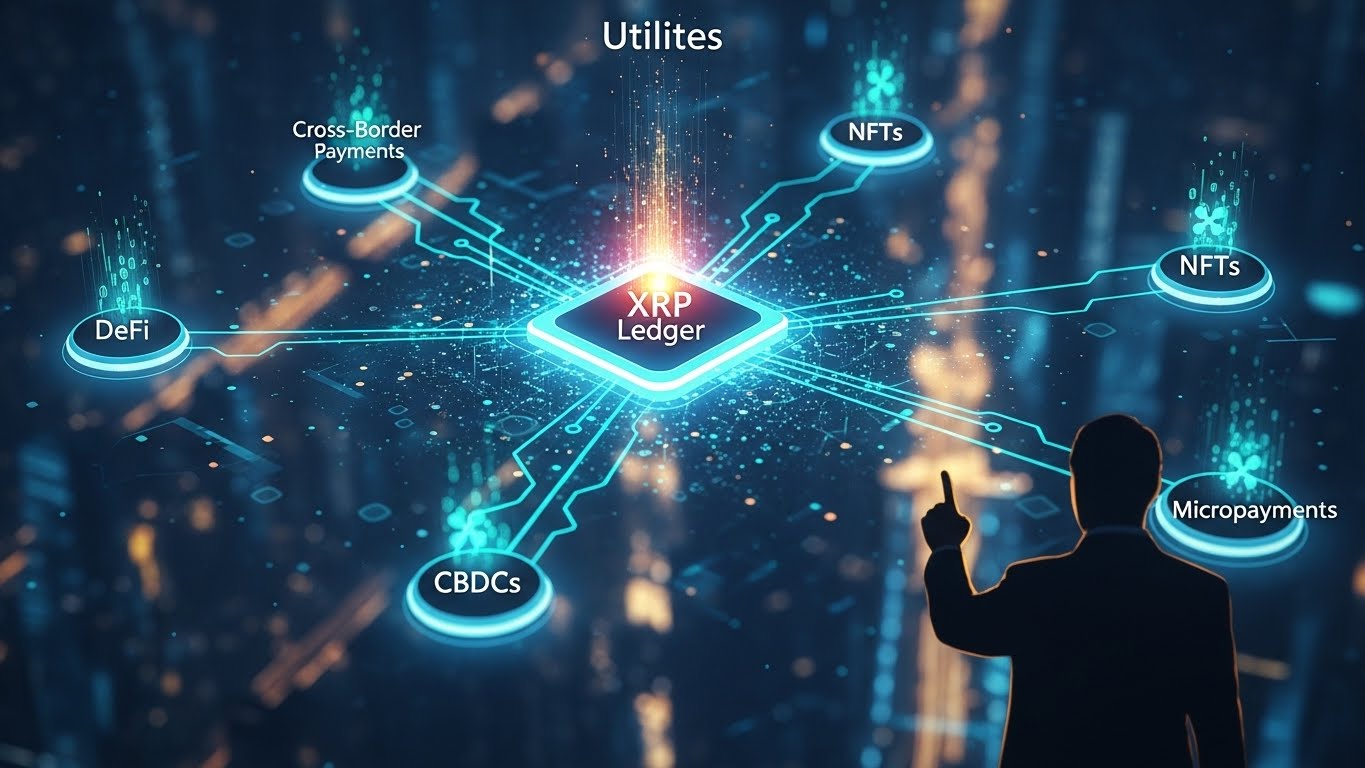

The XRP Ledger has been around for more than a decade, but its utility profile is suddenly back in the spotlight. A senior Ripple executive recently emphasized that the ledger is not just another blockchain competing for hype – it is purpose-built infrastructure for high-volume financial settlement and tokenized value flows.
This renewed attention comes at a time when the crypto market is shifting away from speculative narratives toward real-world utility, institutional DeFi, and tokenized assets. In that context, the XRP Ledger (often called XRPL) looks increasingly like a network designed ahead of its time: a fast, low-cost, and reliability-focused blockchain optimized for payments and financial products rather than meme tokens and congestion.
At the same time, on-chain data shows a dramatic expansion in XRP Ledger payment usage, with transactions surging over recent years and new DeFi, stablecoin, and tokenization projects launching across the ecosystem. Global organizations, from fintech firms to traditional finance players, are exploring or actively building on XRPL to move real-world assets, manage collateral, and experiment with regulated on-chain finance.
Ripple executive puts XRP Ledger utility in the spotlight
What makes the XRP Ledger’s utility profile stand out?
Purpose-built for high-volume settlement
From day one, the XRP Ledger was architected as a payments-first blockchain. Instead of focusing on maximizing programmability at any cost, the protocol prioritized speed, finality, and low fees for value transfer.
This kind of environment is ideal for high-volume financial settlement, where institutions need predictable performance and cannot afford extreme fee spikes during periods of market stress.
Low fees, reliability, and a utility-first philosophy
This utility-first design stands out in an era where many networks experiment with complex tokenomics and aggressive value capture for stakers. For developers, enterprises, and institutions seeking predictable behavior, a simpler, utility-focused model can be an advantage.
XRP Ledger and tokenized finance
Infrastructure for tokenized assets and real-world value
A core reason the XRP Ledger’s utility profile is drawing fresh attention is its emerging role in tokenized finance and real-world asset (RWA) tokenization.
The World Economic Forum recently spotlighted XRPL in connection with a major private equity tokenization initiative. The project, backed by a BlackRock-linked fund, uses the XRP Ledger to bring over $1 billion in private equity exposure on-chain, building on earlier experiments such as tokenized U.S. Treasuries launched on XRPL in 2024.
These kinds of deployments show that the network is no longer just a theoretical solution for on-chain assets.
Institutional DeFi, stablecoin payments, and collateral
Ripple’s own insights have described how the XRP Ledger is rapidly positioning itself as a leading chain for two powerfu
This focus on institutional DeFi differentiates XRPL from purely retail-focused ecosystems. Its ledger-level features and consensus model help provide a dependable base for enterprise-grade use cases that need both speed and predictability.
Payments growth: hard data behind the utility narrative
Marketing claims about utility are one thing; on-chain data is another. In the last couple of years, XRP Ledger payment usage has surged dramatically.
Analytics platforms tracking XRPL show that weekly payment transactions have grown by more than 430% in under two years, with volumes reaching over 8 million payments per week at recent peaks. Payments now account for the majority of activity on the ledger, underscoring that actual value transfer, not just speculative activity, is driving much of the network’s throughput.
In other words, the data backs up the Ripple executive’s claim that the ledger is being used as an engine for high-volume financial settlement rather than an idle platform waiting for adoption.
DeFi, stablecoins, and the expanding XRPL ecosystem
While XRPL began as a payments-focused ledger, it is now moving decisively into DeFi, stablecoins, and on-chain liquidity.
Ripple and ecosystem teams have championed developments such as an EVM-compatible sidechain and new assets like RLUSD, a Ripple-issued stablecoin, which extend XRPL’s reach into both retail and institutional DeFi. Meanwhile, DeFi aggregators report that total value locked (TVL) on XRPL has been climbing, with decentralized exchanges, lending protocols, and liquidity pools gradually taking shape.
Ripple executives have argued that tokenization could unlock tens of trillions of dollars in value over the coming decade, with XRPL providing a foundation for that shift. In this view, the ledger becomes a bridge between traditional financial instruments and on-chain capital markets, where These trends strengthen the utility narrative behind the XRP Ledger, showing that it is evolving alongside the broader DeFi and RWA tokenization landscape.
How XRP Ledger compares with other layer-1 blockchains
The crypto world is crowded with layer-1 networks chasing user attention. Ethereum, Solana, and many others compete on speed, decentralization, and ecosystem size. So where does the XRP Ledger fit?
Recently, another Ripple executive, Luke Judges, drew parallels between XRPL and Solana, arguing that while the XRP Ledger has strong technology and developer tools, it can learn from Solana’s focus on aggressive execution, ecosystem growth, and clear go-to-market tactics.
This positioning makes XRPL attractive to players who want predictable, utility-driven infrastructure for payments and tokenized assets, even if they experiment with more expressive platforms for certain kinds of DeFi or gaming apps.
Dual utility: payments plus wealth storage
Another aspect of the XRP Ledger’s utility profile that has attracted analyst interest is its dual role in payments and value storage. Market commentators have argued that XRP and XRPL could become a compelling play for future crypto exchange-traded products (ETPs and ETFs) because they combine a live payments network with a token that can serve as a bridge asset and store of value.
If regulators continue to open the door to more crypto-based ETFs and institutional products, networks with strong, demonstrable utility – like the XRP Ledger – could stand out among a crowded field of assets.
Why the fresh executive attention matters for XRP holders
First, it reassures institutional partners that Ripple remains committed to advancing XRPL as a utility-focused settlement and tokenization platform, rather than pivoting into purely speculative ventures.
Second, it nudges developers and startups to consider XRPL for new payments, DeFi, and RWA projects, particularly those needing predictable fees and compliance-friendly infrastructure.
In short, the fresh attention is a reminder that XRP’s value proposition rests heavily on the utility and adoption of the XRP Ledger itself.
Risks and challenges to watch
None of this means the XRP Ledger’s path is risk-free. Even with a strong utility profile, XRPL faces several challenges:
Regulatory uncertainty remains a recurring theme for Ripple and XRP, especially as different jurisdictions refine their approaches to tokenization, stablecoins, and securities law. This can impact how quickly institutions are willing to deploy large-scale tokenized products on XRPL.
Competition is intense. Other networks are racing to capture the same institutional DeFi and RWA tokenization narrative, sometimes with aggressive incentives and highly flexible smart contract environments. XRPL must continue to evolve its ecosystem – including tooling, documentation, and developer experience – to stay competitive.
Technological expectations are rising. As volumes grow and more complex use cases emerge, the ledger must keep delivering on performance, security, and feature upgrades, such as enhanced smart contract capabilities, improved interoperability, and better programmability for sophisticated financial products.
Nevertheless, the fact that Ripple executives are publicly emphasizing the XRP Ledger’s real-world role suggests that the company is fully aware of these challenges and is leaning into them rather than backing away.
Conclusion
The renewed spotlight from a Ripple executive on the XRP Ledger’s utility profile is a timely reminder of what makes XRPL unique in the crowded blockchain landscape. It is not just about flashy on-chain games or speculative tokens. It is about:
A payments-optimized ledger processing millions of transactions with low fees and fast settlement.
A maturing ecosystem for tokenized assets, stablecoins, and institutional DeFi, where real-world financial products are moving on-chain.
A network increasingly recognized by global organizations and analysts as a serious candidate for the next wave of tokenized finance and ETF-grade assets.
For investors, developers, and institutions, the message is clear: if you are evaluating blockchains based on utility, scalability, and real-world use cases, the XRP Ledger deserves a fresh, serious look. Its story is far from over – in many ways, the most important chapter is just beginning.
Frequently Asked Questions
Q; What did the Ripple executive say about the XRP Ledger’s utility?
The Ripple executive emphasized that the XRP Ledger is designed for scaled financial activity rather than just speculative use. His comments highlighted XRPL as infrastructure for high-volume settlement, especially in areas like tokenized finance, cross-border payments, and on-chain financial products. In particular, he described the ledger as purpose-built to support real-world settlement flows and a wide range of tokenized instruments, reinforcing XRP Ledger’s role as serious financial plumbing rather than a purely experimental network.
Q; How is the XRP Ledger used in tokenization and real-world assets?
The XRP Ledger is increasingly being used as a platform for tokenized assets and real-world value flows. Projects have brought tokenized U.S. Treasuries and private equity exposure onto XRPL, with one initiative involving over $1 billion in private equity tokenized using infrastructure connected to the ledger. These deployments show how XRPL can host regulated, institution-grade products, allowing investors to access traditional assets in a more flexible, on-chain format while still maintaining compliance and robust custody.
Q; Is the XRP Ledger only for payments, or does it support DeFi as well?
Although the XRP Ledger was originally built as a high-speed payments network, it is now expanding into DeFi and stablecoin ecosystems. An EVM-compatible sidechain, new stablecoins such as RLUSD, and a growing base of decentralized exchanges and lending protocols have turned XRPL into a broader DeFi and liquidity platform. While its DeFi ecosystem is still smaller than that of Ethereum, its focus on institutional DeFi, low fees, and tokenized collateral positions XRPL as a strong contender in utility-driven decentralized finance.
Q; How does XRP Ledger usage today support its long-term value?
Long-term value for XRP is closely linked to how actively the XRP Ledger is used for real-world purposes. On-chain data shows a 430%+ increase in payment transactions over the last couple of years, with millions of payments processed weekly. This level of activity suggests that businesses and users are consistently relying on XRPL for fast, low-cost settlement, which can create ongoing demand for XRP as a bridge asset and liquidity tool. As more tokenized assets, stablecoins, and DeFi services launch on XRPL, the ledger’s expanding utility profile adds depth to XRP’s long-term investment narrative.
Q; What should investors and builders watch next for the XRP Ledger?
Investors and builders should pay attention to several key areas as the XRP Ledger continues to evolve. First, watch for new tokenization projects and institutional partnerships, especially those involving large-scale tokenized funds, stablecoins, or real-world asset collateral. Second, track progress on DeFi infrastructure and EVM-compatible components that make it easier to build sophisticated applications on or around XRPL. Third, monitor regulatory developments and potential ETF or ETP products that reference XRP and the XRP Ledger’s utility. Together, these factors will help determine how strongly XRPL’s utility profile translates into lasting adoption, network effects, and long-term value.
See more;Ripple Stablecoin delay will be needed in 2024