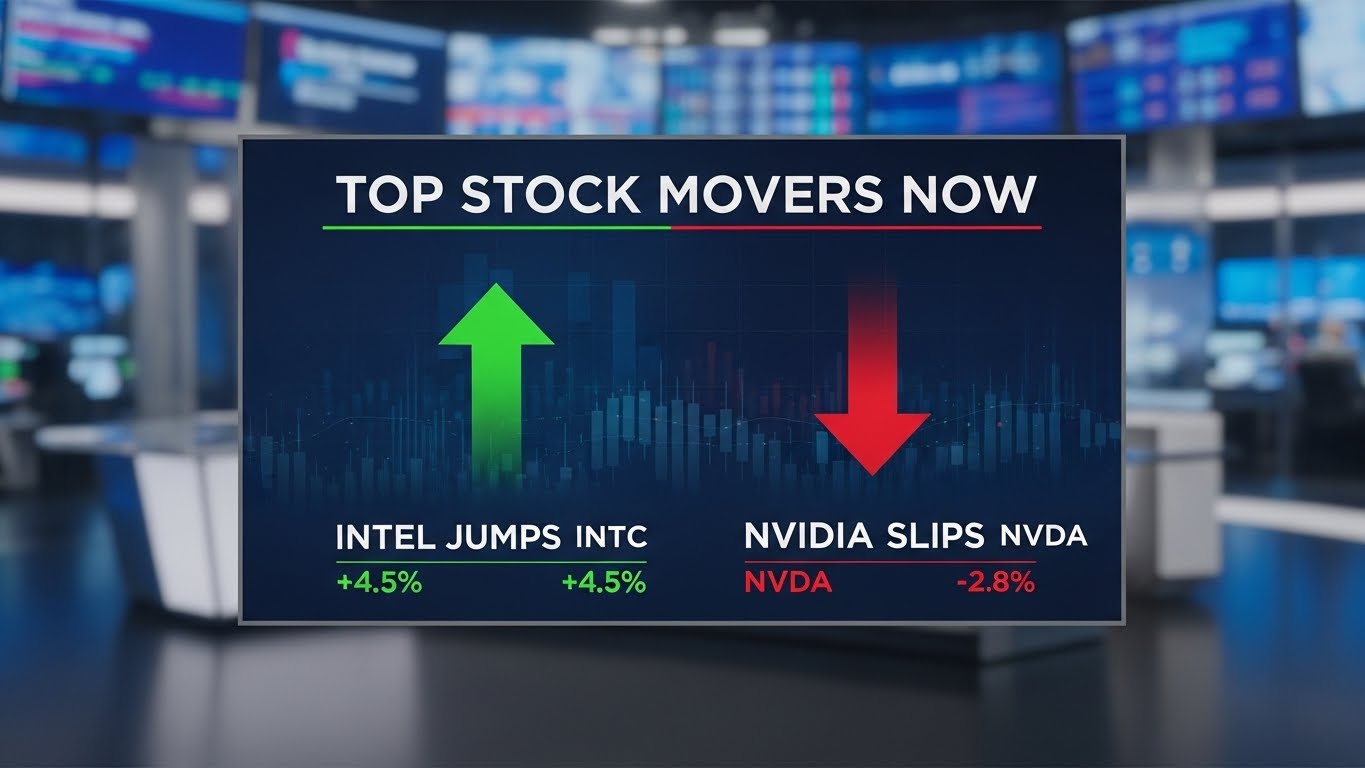

On a quiet, holiday-shortened Black Friday session, top stock movers now are telling a very loud story about where money is flowing in today’s market. Chip giant Intel is leading the S&P 500 higher with a sharp gain of around 8%, while Nvidia and Oracle are under pressure, slipping almost 2% each. At the same time, Bitcoin’s price near $92,000 is helping lift crypto-related stocks as traders reassess risk after a volatile month.
Even though trading volumes are light, the stock market today is sending important signals. Tech and semiconductor stocks remain at the center of attention, AI-focused names are taking a breather, and the crypto market is stabilizing after a steep pullback from six-figure Bitcoin levels. For traders and investors, understanding why these names are moving can offer clues about sentiment in growth stocks, value plays, and digital assets all at once.
In this detailed breakdown, we will walk through the key movers, the macro backdrop, and what today’s action might mean for your next move—whether you are watching S&P 500 gainers and losers, crypto charts, or both.
Market Overview: A Quiet but Telling Black Friday Session
 U.S. equities are modestly higher in a shortened Black Friday session, following Thursday’s holiday closure. All three major indexes are up, with the Dow Jones Industrial Average leading, while the S&P 500 and Nasdaq Composite post smaller advances. Because markets close early and many institutional players are away from their desks, trading volume is thinner than usual. That often means individual stock moves can appear outsized, but it also helps highlight where investors are truly focused when they do step in.
How the Major Indexes Are Trading Today
The top stock movers now are concentrated in a few sectors—semiconductors, consumer discretionary, health care, and crypto-linked equities. Intel’s surge is providing a meaningful boost to the S&P 500, while drag from Nvidia and Oracle is offset by gains in other large caps. Even with Intel’s strength, the broader tech sector is only slightly higher, underscoring a more selective risk-on tone. A specialized tech-heavy fund, the Roundhill Magnificent Seven ETF (MAGS), is up only about 0.3%, reflecting how gains are uneven within mega-cap tech and AI stocks.
Holiday Liquidity and Volatility
Black Friday trading tends to be dominated by retail flows and shorter-term strategies. With fewer institutional orders, price swings in the top stock movers now can be exaggerated, yet they still offer valuable information. An 8% jump in a mega-cap name like Intel on a lighter-volume day still points to a strong underlying narrative and real demand. Likewise, a roughly 2% drop in Nvidia and Oracle signals profit-taking or a pause in previously strong trends, rather than panic selling.
Intel Leads the Top Stock Movers Now
Intel is the standout performer of the session, rising around 8% and ranking as the top S&P 500 mover on a percentage basis. Investopedia+1 This is a notable pop for a mature blue-chip stock, and it comes after months of renewed optimism around Intel’s turnaround and AI strategy.
What’s Driving Intel’s Rally?
There are several layers behind Intel’s recent strength and its prominent spot among top stock movers now: Intel has been engaged in a sweeping strategic overhaul, investing heavily in chip manufacturing capacity, foundry services, and advanced process technology. Recent analysis points to Intel’s share price being up more than 70% year-to-date as investors grow more confident in its ability to claw back share from rivals like AMD, Nvidia, and ARM-based competitors.
Beyond internal changes, Intel has benefited from high-profile partnerships and investments from industry peers and major institutions. Earlier deals—including a multibillion-dollar stake from Nvidia and other strategic relationships—sent a strong signal that Intel remains central to the AI chip race, data centers, and cloud infrastructure. Today’s move likely reflects a combination of investors re-rating the stock, short covering, and the ongoing narrative that Intel is one of the more undervalued semiconductor stocks relative to the broader AI boom.
What the Move Means for Chip Investors
For traders and long-term investors, Intel’s outperformance has a few key implications: Intel is re-establishing itself as a core holding for investors who want exposure to AI infrastructure but at a lower valuation than Nvidia or some hyper-growth chip names.
The stock’s sharp gain today shows that the market is willing to reward credible turnaround efforts, especially when they align with structural themes like cloud computing, edge AI, and data center demand. At the same time, Intel’s rally highlights how volatile chip stocks can be. Investors need to balance enthusiasm with the reality that execution risk remains and competition in semiconductors is intense.
Nvidia and Oracle Slip as AI and Cloud Take a Breather
While Intel rallies, Nvidia and Oracle are going the other way. Both stocks are down around 1.8% and 2.2%, respectively, making them among the bigger decliners in the S&P 500 today. In a year dominated by AI euphoria and aggressive buying of cloud and data center shares, a mild pullback in these names is not unusual. But seeing them fall while Intel surges is a reminder that the market is rotating within the same theme, not abandoning it entirely.
Nvidia’s Pullback in Context
Nvidia has been one of the defining winners of the AI revolution, supplying high-end GPUs that power everything from large language models to advanced training clusters. After an extraordinary run, a 1–2% daily decline is small in percentage terms, but psychologically important. Today’s slide looks more like healthy consolidation than a trend reversal. Investors may be: For traders watching top stock movers now, Nvidia’s red day next to Intel’s rally underscores a subtle shift: capital is not leaving the AI theme, but it is broadening out to other players.
Oracle’s Slide and the Cloud Software Story
Oracle’s drop of about 2.2% is another part of this rotation story. The company has been working hard to reposition itself as a modern cloud and AI platform, leveraging its infrastructure offering and partnerships to stay relevant in a market dominated by Amazon, Microsoft, and Google. For investors, the move in Oracle highlights that even solid cloud computing names can face short bursts of weakness as the market reassesses growth expectations, interest rates, and IT spending budgets.
Health Care and Consumer Names in Focus
On the downside, pharmaceutical heavyweight Eli Lilly is off nearly 3%, making it the biggest S&P 500 decliner. Given how strongly Lilly has performed on the back of blockbuster weight-loss and diabetes drugs, a drop of this magnitude likely reflects valuation pressure and normal volatility rather than a structural shift in the story.
On the consumer side, the Black Friday backdrop is mixed. Alcohol and spirits group Brown-Forman is up around 1.5%, and athletic apparel leader Lululemon is more than 2% higher. In contrast, electronics retailer Best Buy is down over 1% despite recently reported earnings. This split suggests that investors remain selective with consumer stocks. Companies perceived as premium brands with pricing power or stable demand—like Lululemon or Brown-Forman—are holding up. Retailers more exposed to discounting, cyclical spending, or hardware upgrades face tougher scrutiny.
Crypto-Linked Stocks Ride Bitcoin’s Rebound
One of the more interesting stories among the top stock movers now is the strength in crypto-related equities. Shares of Coinbase Global are up nearly 4%, and MicroStrategy, known for its large Bitcoin holdings, is up about 2.4%. These moves are tightly linked to today’s Bitcoin price near $92,000, which marks a dramatic recovery from lows near $80,000 earlier in the month. Recent analysis notes that Bitcoin has been oscillating around the $90,000–$92,000 band after a sharp drop from record highs above $120,000, and sentiment has shifted from euphoria to caution. When Bitcoin stabilizes after a steep decline, crypto exchange stocks, miners, and companies with large digital-asset exposure often enjoy a relief rally. That is exactly what we’re seeing today.
Bitcoin Price Near $92,000: Why It Matters
The headline Bitcoin price near $92,000 is more than just a number. After peaking around $126,000 in October, Bitcoin has endured roughly a 30% correction, sliding toward the low $90,000s and briefly dipping below $90,000 before rebounding. Today, Bitcoin’s stability around the $92K level is encouraging some traders to tentatively re-enter the crypto market, while others remain wary of further downside.
From Six-Figure Highs to the $92K Zone
Several factors have driven Bitcoin’s drop and subsequent stabilization: A wave of profit-taking after new all-time highs.
Rising uncertainty about the U.S. Federal Reserve’s next moves and the path of interest rates. Outflows from spot Bitcoin ETFs, with billions pulled over recent weeks. Despite the turbulence, some on-chain and valuation metrics show Bitcoin potentially undervalued, with measures like the 30-day MVRV (market value to realized value) returning to levels last seen during prior corrections. That doesn’t guarantee a rebound, but it helps explain why Bitcoin’s price near $92,000 is attracting dip buyers and sustaining gains in Bitcoin-sensitive equities.
What Bitcoin’s Level Signals for Risk Sentiment
Bitcoin’s behavior is often seen as a barometer for risk appetite across markets. When Bitcoin and other cryptos stabilize after a crash, it can signal: Reduced forced selling and liquidations. A potential bottoming process in speculative corners of the market. A slightly better environment for high-beta assets, including growth stocks and small caps. At the same time, the steep correction and ETF outflows highlight that the crypto bull cycle may be in a more mature, choppier phase. For investors, that means position sizing and risk management are crucial, especially when chasing volatile rebounds in top stock movers now connected to Bitcoin.
Short-Term Traders: Volatility and Momentum
For active traders, top stock movers now offer immediate trading setups: Intel’s surge may appeal to breakout traders looking for continuation, though chasing an 8% move always carries risk if momentum fades.
Nvidia and Oracle’s modest declines may attract mean-reversion strategies, particularly if traders believe the underlying AI and cloud computing trends remain intact.
Crypto-linked names like Coinbase and MicroStrategy offer high volatility tied to Bitcoin’s swings, making them attractive to day traders comfortable with rapid intraday moves. Because the session is shortened and liquidity is thinner, traders should be wary of slippage, wider spreads, and sudden reversals. Tight risk controls and clearly defined entry and exit points are essential.
Long-Term Investors: Separating Noise from Narrative
Long-term investors watching top stock movers now should focus less on minute-to-minute price action and more on the stories behind the moves: Intel’s strength fits into a larger narrative of a multi-year turnaround in semiconductors, foundry services, and AI. If you believe in that thesis, today’s pop may simply confirm the trend rather than mark the end of it. Nvidia and Oracle’s declines are small compared to their long-term runs. For believers in AI infrastructure and cloud transformation, such pullbacks can be opportunities to add at more reasonable prices rather than reasons to panic. Bitcoin’s level around $92,000 is a reminder that crypto cycles are extreme in both directions. Long-term allocation decisions should be based on risk tolerance and time horizon, not just on headline prices or short-term fear and greed.
Final Thoughts
 Today’s market action may be happening in a low-volume, holiday-shortened environment, but it still carries meaning. Intel’s outsized gain, Nvidia and Oracle’s modest retreat, and Bitcoin price near $92,000 together paint a picture of a market that remains heavily focused on technology, AI, and digital assets, yet is increasingly selective within those themes. Leadership within semiconductors and AI stocks is broadening, not collapsing. High-flying winners like Nvidia and Oracle can pull back without breaking their long-term stories.
Crypto remains volatile, but Bitcoin’s stabilization near $92K has given a short-term boost to crypto-related equities and eased some fears of a deeper crash. Whether you are a short-term trader scanning top stock movers now for opportunities, or a long-term investor trying to refine your exposure to tech and crypto, days like this provide a valuable real-time stress test of your strategy. The challenge is to distinguish between noise and genuine information—and to act only when the odds truly favor you.
FAQs
1. Why is Intel stock up so much today?
Intel is among the top stock movers now because it has become a key beneficiary of renewed optimism around its turnaround, AI strategy, and manufacturing push.
2. Why are Nvidia and Oracle down while Intel is up?
Nvidia and Oracle are both slipping around 2%, even as Intel rallies, largely due to profit-taking and a short-term rotation within the AI and cloud theme. Nvidia has delivered massive gains throughout the AI boom, and Oracle has ridden the wave of cloud adoption.
3. What does Bitcoin price near $92,000 mean for the crypto market?
Bitcoin trading near $92,000 signals that the market is trying to stabilize after a sharp correction from record highs around $126,000. The move reflects a shift from speculative euphoria to a more cautious tone, with ETF outflows and macro uncertainty weighing on sentiment.
4. Are today’s top stock movers a sign of a bigger trend?
Some of today’s moves, like Intel’s strength and Bitcoin’s stabilization, align with longer-running themes: the rise of AI infrastructure, the reshaping of the semiconductor industry, and the maturation of the crypto market.
5. How should I respond as a long-term investor to these moves?
For long-term investors, the best response is usually patience and selective action rather than chasing every top stock mover now. If Intel’s rally reinforces your conviction in its multi-year turnaround, you might use pullbacks instead of spikes to add exposure.